
Guides
Tennis ladder variants: pyramid, swap and points ladders
A standard tennis ladder ranks players in one list, and you climb by challenging people above you (how a standard ladder works). The variants change what a win does to that list. On a swap ladder, the two players trade places. An insert-and-bump ladder slots the winner in and pushes everyone between down one. A pyramid puts players in rows you climb one at a time. A points ladder ranks by a points total.
Box ladder hybrids add monthly groups with promotion and relegation. Each variant below comes with a club that publishes its rules, and with the way it tends to break.
Challenge (swap) ladder: what happens when the lower player wins?
In the challenge ladder format, you may challenge players above you, usually within a set number of places. Sport New Zealand's guide to tournament types says there is usually a limit, and club rulesets agree on small numbers: Stowe Tennis Club allows two spots, while Wells Tennis Club and Lacey Green & Loosley Row allow three.
Clubs settle the challenger's win in one of two ways.
Straight swap or insert and bump?
Straight swap. The two players change places, as Sport New Zealand describes the classic ladder. Beat the player three rungs above you and you take their rung while they take yours. Nobody in between moves, which means the loser falls the whole gap.
Insert and bump. The winner moves directly above the player they beat, and everyone from the loser down to the winner's old place drops one. Lacey Green spells this out: the loser and all others below the winner move down one position. Wells and Brixworth Tennis Club word it as moving "immediately above" the beaten player. Henley Tennis Club and Stowe say the winner takes the spot and the beaten player moves down one. The loser drops one place instead of the whole gap.
In both versions, a challenger who loses changes nothing. Wells, Brixworth and Stowe all say both players simply stay where they are.
Where swap ladders stall
A swap ladder only moves when people play. Club rulesets keep patching the weeks they don't:
- Inactivity. Brixworth may drop a player one place after four weeks without a match. At Stowe, anyone from fourth place up who sits out two ladder weeks in a row slides down a spot.
- Stuck at the bottom. Brixworth gives every player one Wild Card challenge beyond the normal range, though not against the top 10, and new players start at the bottom with one. Lacey Green lets a new player challenge anyone in the bottom three places.
- Slow replies. Wells wants a response within 48 hours. Lacey Green expects the challenged player to agree a match within two weeks.
- Repeat challenges. Wells makes a challenger who loses play two other people before a rematch.
- Moving targets. Lacey Green sets positions when the result is recorded, not when the challenge was made, and asks players to play the match even if their places have changed in between.
Sport New Zealand adds one structural limit: a ladder suits a small number of entries only. The arithmetic shows why. On a list of 40 with a reach of three places, a player starting at the bottom needs at least 13 straight wins to reach the top.
Brixworth softens that by widening the reach lower down: players ranked 20th to 10th may challenge four places up, the top nine only three.
Pyramid ladder: what is a pyramid tennis ladder?
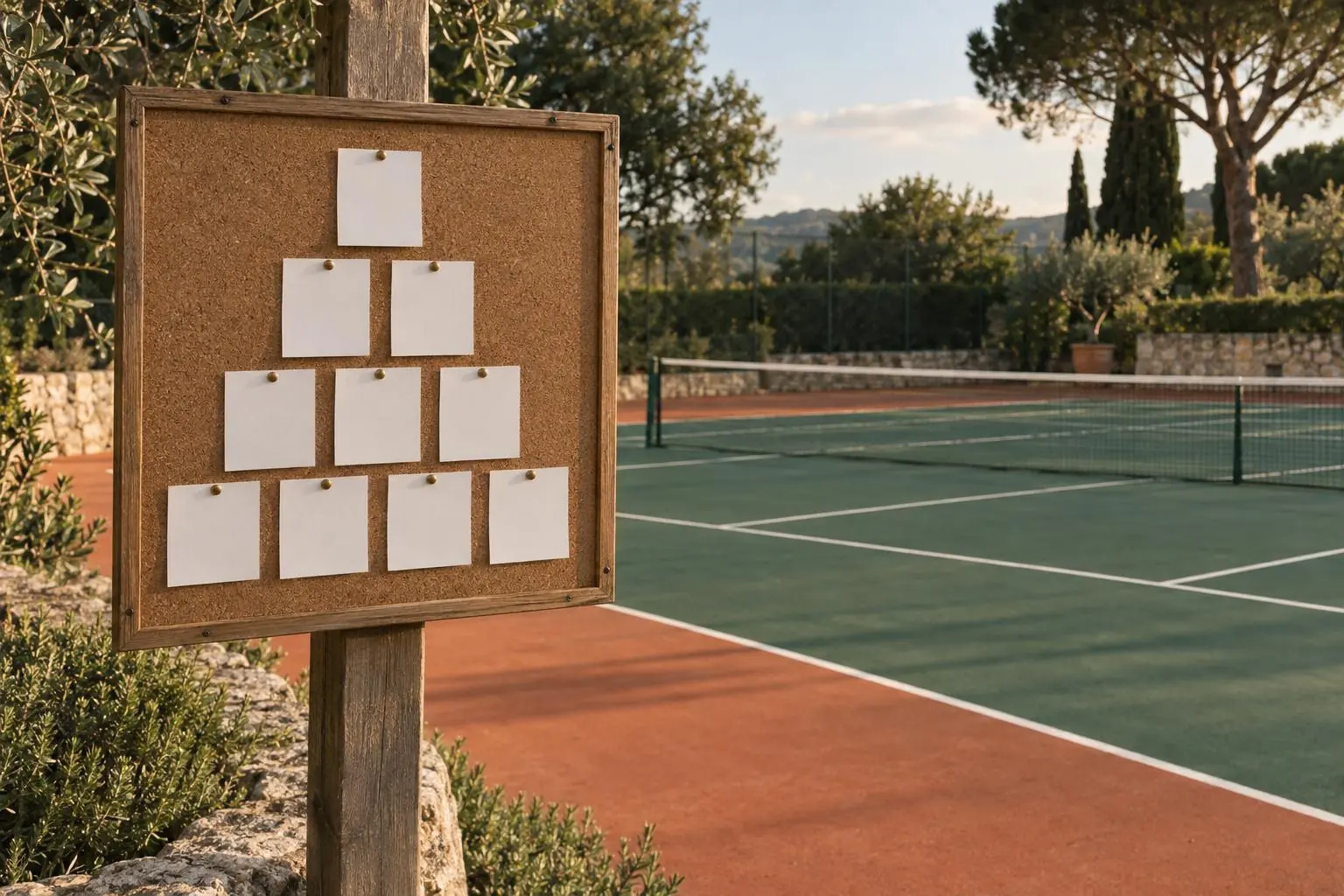
A pyramid places players in horizontal rows instead of one list. Sport New Zealand describes the movement this way. You may challenge anyone in your own row. Once you win there, you may challenge anyone in the row above. A player who loses to someone from the row below changes places with them.
Blaydon Tennis Club still publishes the rules it wrote for its 2016 men's singles pyramid. Ranking runs top to bottom and left to right. You can challenge anyone to your left on your line or anyone on the line above. A winning challenger swaps positions, which can mean moving sideways or up a row. If the defender wins, nothing moves.
Why clubs pick a pyramid
More players have someone to challenge at any moment, because the whole line above is in reach, not just two or three names. Blaydon says a pyramid offers more possibilities to challenge one another and is less likely to stagnate than a ladder. Sport New Zealand says it allows more challenges and can take a larger field.
What goes wrong on a pyramid
A pyramid only works if people accept challenges from below, and Blaydon backs that with a penalty: refuse two challenges without good reason and you drop three places, while the three players below you each move up one. A pyramid also caps the climb at one row per win, so a strong newcomer placed low needs several wins to reach the level where they belong. When a single pyramid gets too big, Blaydon's plan is several pyramids, with the top and bottom three promoted and relegated at the end of the period. At that point it works like a box league built from pyramids.
Points ladder: how does a points-based ladder rank players?
The last two variants stop trading places. On a points ladder, a result moves nobody directly. Each match earns points, and the standings sort by total. Henley Tennis Club's doubles ladder shows how simple a points based tennis ladder can be. Players are scored as individuals, so any four players can make a match. Each player earns 2 points for taking part and 1 for each set won, plus 2 each for going to three sets or 1 for a straight-sets win. At Henley, even a loss earns points; it just earns fewer.
How Deuce runs a points ladder
Deuce uses a points model on every ladder, and the rules state it plainly: points order the standings, so the ladder is not a swap. You challenge anyone up to five rungs above you by default. Your organizer can set a different reach. The default awards, all of which an organizer can change, are:
| Result | Default Deuce Points |
|---|---|
| Played a match, score confirmed | +2 |
| First match against that opponent in 365 days | +1 |
| Won | +10 |
| Won, per rung the opponent was above you | +2 each, up to +10 |
| Lost in a deciding set or match tiebreak | +2 |
One guarantee sits on top of the points. Challenge someone above you and win, and you finish above them when the result confirms. That is the overtake guarantee. Your target is also locked when you send the challenge, so the rung gap that pays out is the one at that moment. Lacey Green's ladder counts places at the moment the result is recorded instead.
The case against points
The usual objection is that volume can beat quality. Davisville Tennis Club awards two separate prizes, one for the top of the ladder and one for most total points, because those can be different people. Deuce answers it in the rules: the +2 for playing and the +1 for a new opponent are capped at 12 points per 30 days, every point expires after 365 days, and a share of your points goes after every 30 days without a played match. What you give up is legibility. On a swap board you can see who beat whom; a points table makes more sense with the scoring page open beside it.
Box ladder hybrids
A box ladder hybrid splits the ladder into small groups that play inside a fixed period, then reshuffles. Two club ladders show the pattern. Davisville, a City of Toronto tennis club, runs its May to September season in boxes of four to six players who each meet once a month. A game won is worth 1 point, the winner gets 3 bonus points and the loser 1. New boxes are drawn each month from the results, and anyone with fewer than three matches that month cannot be promoted. Rosedale Park Tennis Club treats each month as a session, awards 4 points for a win, 2 for a tie and 1 for a loss, and moves the top two in each box up and the bottom two down.
Boxes settle the question of who to play, since your opponents are named for the month. They give up the open challenge, and a box only moves at the end of its period. The box league rules guide goes into group sizes and promotion.
Which ladder variant should you choose?
The table sums up the five variants.
| Variant | How a win moves you | Suits | Usual failure | Published example |
|---|---|---|---|---|
| Straight swap | You and the loser trade places | Small groups that want a simple board | Loser falls the whole gap; idle players block the list | Sport New Zealand guide |
| Insert and bump | You slot in above the loser; the players in between drop one | Club singles ladders | Stalls without inactivity rules and wild cards | Lacey Green, Wells, Brixworth |
| Pyramid | Swap within your row or with the row above | Bigger fields that want more challenges | Climb capped at one row per win; refusals need a penalty | Blaydon Tennis Club |
| Points ladder | Points total decides your place | Players with uneven availability, doubles with rotating partners | Volume over quality unless capped; harder to read | Henley doubles, Deuce |
| Box hybrid | Monthly points table, top up and bottom down | Groups that want named opponents each month | No open challenge; moves only at period end | Davisville, Rosedale Park |
If you also run knockouts or round robins, the tournament formats comparison puts a ladder beside those.
When Deuce is not the right fit
Deuce runs one model, the points ladder above, and that part is not configurable. If your club wants a straight swap, insert and bump, or a pyramid board, Deuce does not offer them as options. If you want fixed monthly groups with named opponents, run a box league. No ladder variant guarantees that a match gets played. Deuce makes it more likely with deadlines: you have five days to answer a challenge, and silence past five days is a walkover. If the points model fits, you can start a ladder for your club or group.
Sources and last verified
Last verified: November 20, 2026.
- Sport New Zealand, Types of tournaments and draws (ladder and pyramid tournaments).
- Lacey Green & Loosley Row Padel & Tennis, Club Ladder rules.
- Wells Tennis Club, Singles Ladder.
- Brixworth Tennis Club, Club Ladder Rules.
- Stowe Tennis Club, Ladder.
- Blaydon Tennis Club, Men's Pyramid Challenge.
- Henley Tennis Club, Ladders.
- Davisville Tennis Club, Ladder Rules.
- Rosedale Park Tennis Club, Ladder.
- Deuce Ladder rules, sections 1, 5, 10 and 12, and scoring.