
The open directory
Every ladder on Deuce, with public standings and no login
Every ladder, its standings, its rules, and the match volume it produced last month. No account to read any of it, permanently rather than as a launch promotion.
01 · The format
What a tennis ladder is, in one paragraph
A standing ranking of players who use the same courts. You sit on a rung, challenge somebody a few rungs above you, and if you win you finish above them. Every match you play earns Deuce Points, and the points order the standings. No fixture list, no team, no season handed to you. On Deuce, challenges reach five rungs up, your opponent has 120 hours to answer, and you both have thirty days to play. Individual ladders set their own numbers, and each page prints the ones it uses.
02 · The directory
How to browse
Four filters, all combinable, all in the URL.
City
Or a postcode, which works better in a large city. Distance shows on every card.
Level band
The same five plain descriptions used everywhere: new to competitive tennis, plays social sets, plays club matches, plays at the top of the club or above it, and has a rating and knows it. A rating is never required to browse.
Singles or doubles
Or both.
Season status
Active now, starting soon, or finished. Finished ladders stay readable.
If you are not sure where to start, put in a postcode and change nothing else. Most filter combinations currently return nothing, and that is a real answer about your area rather than a broken page: the empty state tells you which filters produced the zero.
Playing in Ottawa? The Ottawa tennis ladder guide covers public courts, club competition and winter indoor costs.
03 · The card
Public tennis ladder standings, and what each card shows
Specimen card
{{LADDER_NAME}}
Two of those numbers do the work.
Active players
Players with a played match in the last 30 days, never registrations. We publish no registration count anywhere on this site, and there is no field for one in the data behind these cards. Registrations only accumulate: a ladder can carry 40 names of whom three have hit a ball since spring.
Matches in the last 30 days
The closest honest proxy for whether the challenge you send on Monday gets played, and when it is zero it says zero. A ladder with no matches in 30 days gets an inactive label and stays exactly where it is, because pulling it out would cost you the one thing you needed to know about it.
04 · Behind the click
What you get when you click a ladder
That ladder's permanent page. No login screen, no interstitial, no rows blurred out with a signup prompt on top.
The standings, in full
Every rung in order, with each player's display name, played match count, wins and losses. Not a top ten with the rest hidden.
Every played match, with its scoreline
Who challenged whom, the final score, the date. Scroll this before anything else: a tidy top three with no match history underneath is a list of names somebody typed in once.
That ladder's own rules
Challenge range, response window, play window, format, rematch cooldown, decay interval, absence policy, season dates. The organizer is named, with a way to ask a question before you commit.
How to read the standings, if the order looks odd
Somebody near the top on three played matches got there by beating the people above them. Somebody near the bottom on fifteen has been busier than anyone else and is still climbing, which is an ordinary place to be. When two players finish level, a published tiebreaker settles it: matches played, head-to-head, sets won minus lost, games won minus lost, then whose most recent played match came first. Names in gray belong to players on a declared absence or in decay. They are still on the ladder and still count.
Nobody on the list is ahead because they have been there longest. Every point expires 365 days after the match that earned it, so a total converges on the last twelve months and stops there. A player who joined five years ago and one who joined last year hold identical totals if their recent form is identical. Tenure is worth exactly zero.
05 · The open sheet
Why every ladder has a public standings page
So you can check us
Read the standings, the match history and the exact rules before giving anybody an email address. A directory of ladders you cannot open is a marketing page with a search box on it.
So organizers get found
A public page gets indexed and appears on its city page and in the ladder directory. Put a ladder behind a login and it becomes invisible to precisely the players its organizer needs most.
Because that is what a ladder has always been
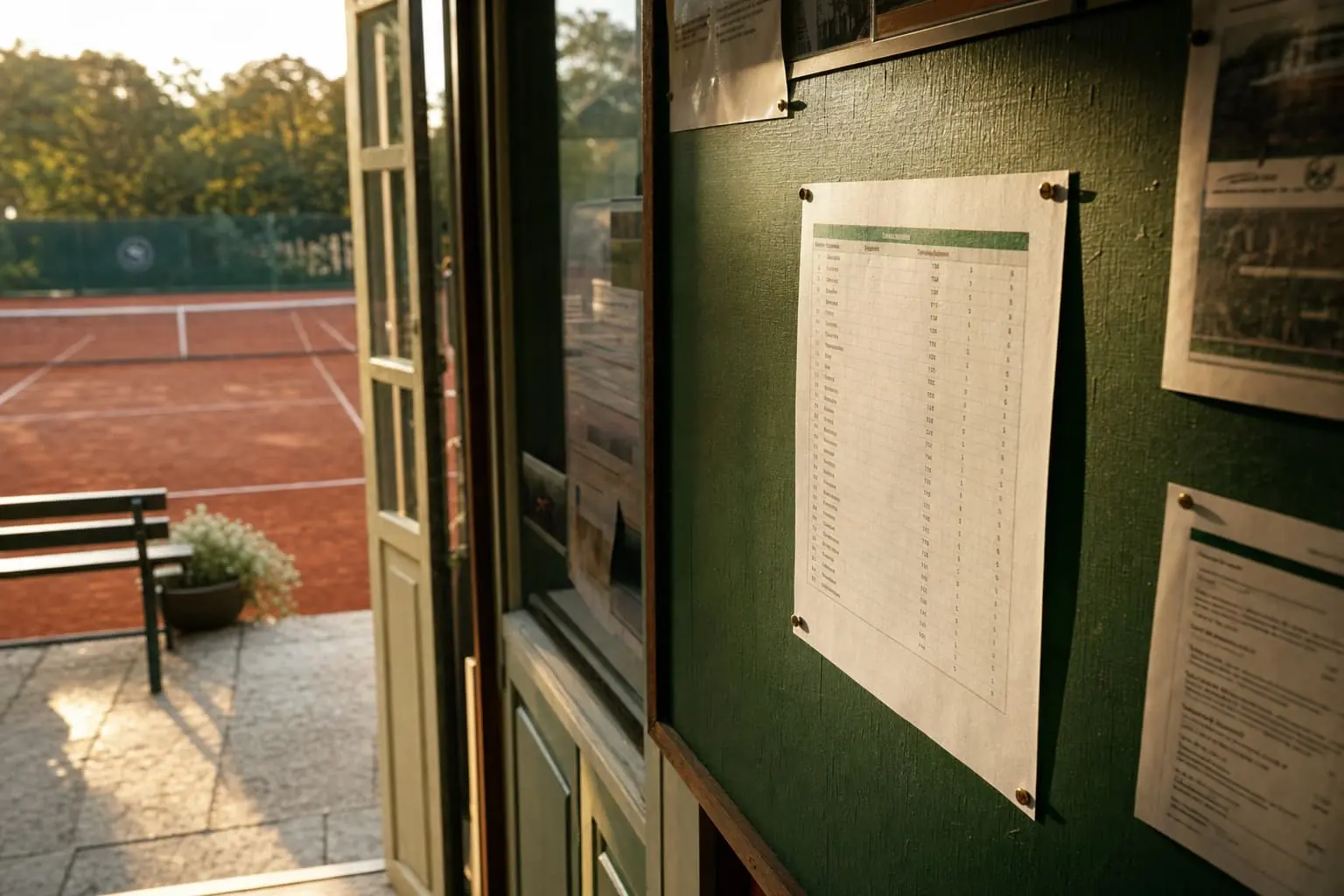
Clubs worked this out long before software: the sheet went on the noticeboard by the door.
Visible on a members-only ladder
- City
- level band
- format
- season dates
- active player count
- matches in the last 30 days
- organizer display name
- a request-to-join button
The counts stay public because a count is what tells you whether asking to join is worth your time.
Withheld on a members-only ladder
- Player names
- rung order
- individual scorelines
An organizer can set this where their club requires it, and nothing else about the listing changes.
06 · By place
Browsing by place instead of by filter
Every Deuce ladder has its own permanent page, and the directory groups them by country, region and city, so a ladder that starts in your town today can be found by somebody searching next March. A city page lists that city's ladders alongside the courts we know about.
Empty places still get a page, and it says so plainly. An empty city page is the link you send to a club committee when you want to make the case for starting the first ladder in town.
A city page also lists the public courts we know about, whether or not a ladder runs there yet. That list is often the more telling number when you are working out whether a ladder is possible where you live.
07 · The industry
Why an open directory is not the norm
Checked in July 2026, three of the four products closest to this one served their browse page as a JavaScript shell. Open one with scripts disabled and there is nothing there, and a page a crawler cannot read will never bring an organizer a single player. One large platform has no ladder format at all, and its nearest equivalent requires a challenge match to be emailed to an administrator, after which the result does not count toward any standings:
Challenge matches must be emailed to the league administrator. These matches do not count toward standings.
Source: published competitor flex league rules, captured July 2026
Score trust is thin too. Of five platforms surveyed, exactly one required both players to verify a score and exactly one published a penalty for faking one. That bar is low enough that you should read a ladder's match history yourself.
08 · One email
The waitlist, and what it is not
One email field exists on this page, underneath the zero you will have already read. The promise is narrow: one message, sent when a ladder matching your filters actually exists. No countdown, no monthly roundup, no sequence of tips while you wait. Grouped by city and level band, the list also tells us where to help launch the next ladder, which is why the form keeps your filters and never asks for your phone number.
09 · The empty state
When there is nothing near you
At launch, this is the state most people land in.
No ladders match that yet
Deuce is new, and ladders start one local group at a time, so plenty of filter combinations return nothing. We show you the zero rather than widening your search silently and pretending it matched.
Widen it yourself
Clear the level filter, or increase the distance. The controls stay where they are.
Or start the first one
If you already play with ten or more people you could name, that group is a ladder. The application takes about five minutes, and the ladder opens for players once it is approved.
Or be told once
Leave an email and we write to you when a ladder matching your filters exists. One email, not a newsletter.
This page does not get padded with ladders 200 miles away, and an empty region is described as an empty region rather than a growing community.
10 · The commitment
The one thing to take from this page
The zero is the answer to the question you came with, delivered before you paid anything or typed an address. A stated value is worth less than a stated ban, so here is what this page will not get:
No login wall after the first few cards
No blurred standings rows with a signup prompt over them
No email box that appears when your cursor heads for the tab bar
No cookie dialog before the cards render
No count anywhere on this site drawn from registrations instead of played matches
Players
If you want to play
Pick a ladder, read its standings and match history, then join.
Organizers
If you want to run one
Your ladder appears here the day it launches, with the same numbers as everybody else's.