
Cities
Tennis ladders in Miami
The Miami singles ladder on Deuce Ladder is open and free to join. You pick who you play, and the two of you pick the court. Miami-Dade County’s Crandon Park Tennis Center on Key Biscayne has 27 courts, booked online up to three days ahead. In Coral Gables, Salvadore Park has 13 lit clay courts at $6 an hour per player for Miami-Dade residents. The wet season, May 15 to October 15, shapes when you play.
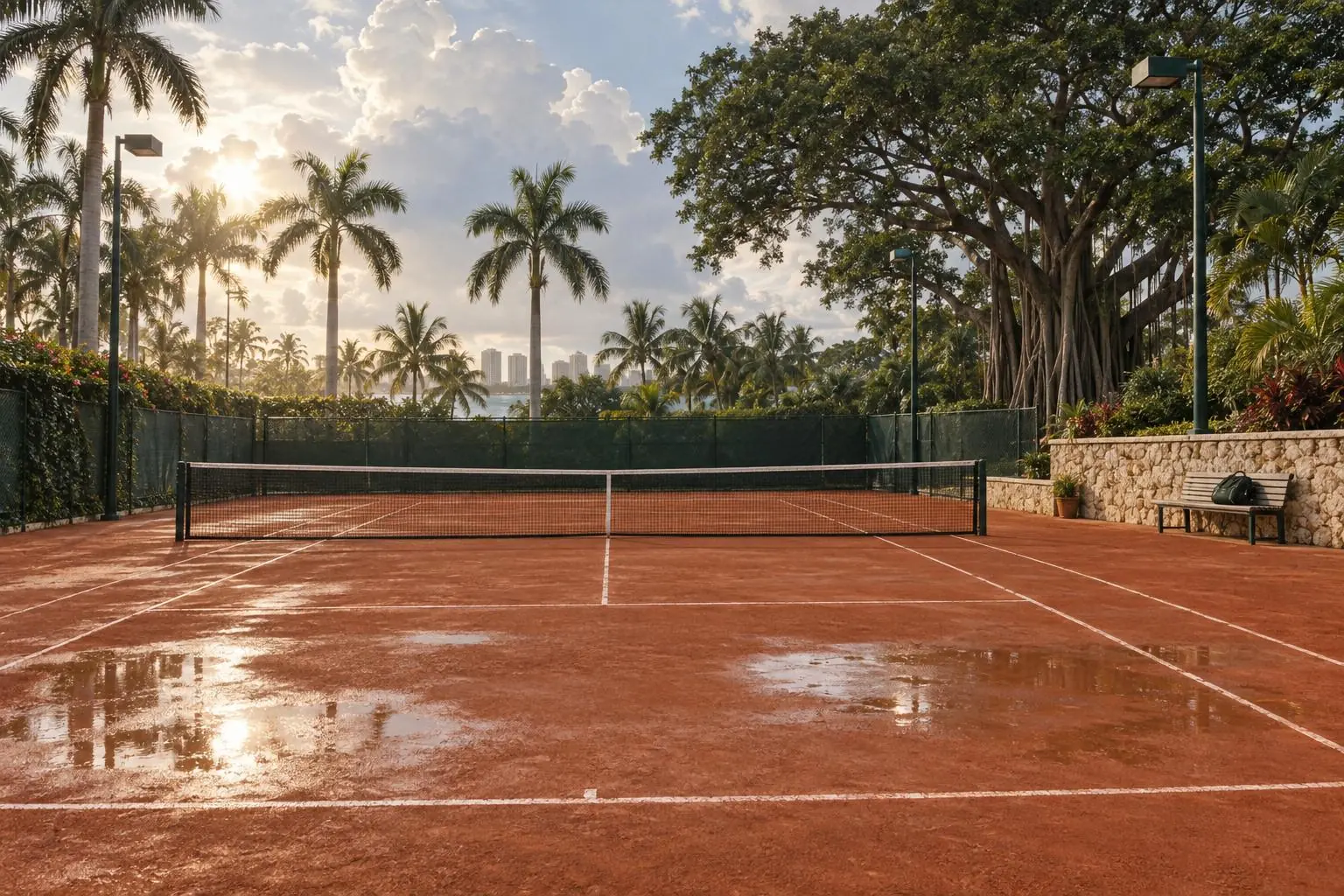
Miami at a glance
| On Deuce | Live count |
|---|---|
| Ladders in Miami | 1 |
| Active players (last 30 days) | 0 |
| Matches played (last 30 days) | 0 |
Ten players is enough to start a ladder. Courts are easy to find here; opponents are the open question. Check the Miami standings or the ladder directory before you count on a match.
Where you would play
Public tennis in Miami belongs to several governments. Miami-Dade County runs Crandon Park and Tropical Park. The City of Miami runs its own tennis centers. Miami Beach, Coral Gables, South Miami and Pinecrest each set their own fees and booking rules, and most of them give residents a lower rate.
Crandon, the two Miami Beach centers and the Coral Gables centers publish the most detail. On price, the lowest published hourly rates are Miami Beach’s $4 resident neighborhood courts, South Miami’s $5 daytime resident rate and Coral Gables’ $6 county-resident day rate. The table lists facilities, not open court time. Fees are per player, per hour, unless the row says otherwise. “Not stated” means the operator’s own pages did not give that detail on October 28, 2026.
| Venue | Area | Courts | Surface | Lights | Booking | Adult fee |
|---|---|---|---|---|---|---|
| Crandon Park Tennis Center (county) | 7300 Crandon Blvd, Key Biscayne | 27 | Not stated | Yes; off 15 minutes before closing | Online, 3 days ahead, one court at a time | Set by the county per player, per hour; venue rate not stated online |
| Tropical Park Tennis Center (county) | Tropical Park | 12 | Not stated | Yes | Reservations accepted | Not stated |
| Ives Estates Tennis Center (county) | 1475 NE 205th St | Not stated | Not stated | Not stated; open to 9:30 p.m. weekdays | Not stated | Not stated |
| Flamingo Park Tennis Center (Miami Beach) | 11th St and Jefferson Ave | 17 | Not stated | Yes | App or website; nonmembers 1 day ahead | $12 resident, $20 nonresident, plus $8 light fee |
| Miami Beach Tennis Center | North Shore Park, Miami Beach | 12 | 10 Har-Tru, 2 hard | Yes | App, from 7:30 a.m. the day before; singles 1 hour | $12 resident, $20 nonresident, plus $8 light fee |
| Palm Island and Polo Park courts (Miami Beach) | Neighborhood parks | Not stated | Not stated | Not stated; open to 9 p.m. | App, 1 day ahead at 7 a.m.; up to 2 hours | $4 resident, $11 guest; Palm Island takes no nonresident bookings |
| Normandy Shores, Fairway and Bayshore courts (Miami Beach) | Neighborhood parks | Not stated | Not stated | None at Normandy Shores | App, 1 day ahead from 7:30 a.m.; singles 1 hour | $4 resident, $11 nonresident or guest |
| Salvadore Park Tennis Center (Coral Gables) | 1120 Andalusia Ave | 13 | Clay | Yes | RecTrac online | $6 day, $10 after 5 p.m. for Coral Gables and Miami-Dade residents; $10.50 and $13.50 otherwise |
| Biltmore Tennis Center (Coral Gables) | 1150 Anastasia Ave | 10 | Not stated | Not stated; open to 9 p.m. weekdays | RecTrac online | Same as Salvadore |
| Dante Fascell Park (South Miami) | 8700 SW 57th Ct | 6 | Har-Tru clay | Yes | PlayByCourt | Hourly: $5 resident, $8 nonresident by day; $6 and $12 in the evening |
| Coral Pine Park (Pinecrest) | 6955 SW 104th St | Not stated | Not stated | Not stated; open to 10 p.m. | Online, phone or in person, up to 2 weeks ahead | Not stated |
| Kirk Munroe Tennis Center (City of Miami) | 3101 Florida Ave | Not stated | Not stated | Not stated; open 8 a.m. to 10 p.m. | Not stated | Posted on site |
| Moore Park (City of Miami) | 765 NW 36th St | Not stated | Not stated | Not stated | Not stated | Posted on site; adult clinics $10 a class |
| Morningside Park (City of Miami) | 750 NE 55th Ter | Not stated | Not stated | Not stated | Not stated | Posted on site |
Miami-Dade County: Crandon Park and Tropical Park
Crandon Park, on Key Biscayne, has 27 courts. Since January 16, 2026, USTA Florida has run it for the county under a one-year interim permit. Booking is online through the county’s park system. It opens three days ahead, and you can hold only one court at a time.
The county’s posted rules split the day at 5 p.m. A prime-time rate applies after that, and the lights go off 15 minutes before closing. A rained-out booking comes back as credit on your Park Link account, not as cash. The county doesn’t publish Crandon’s current court rate online. Ask when you book.
Tropical Park has 12 lit courts and takes reservations. On weekdays it opens at 3:30 p.m. and closes at 9 p.m., with extra morning hours on Tuesday and Thursday. Weekend hours are mornings only.
Miami Beach
For a singles match on clay, start with the Miami Beach Tennis Center at North Shore Park. Miami Beach has two staffed tennis centers and five neighborhood court sites. At both centers a player pays $12 an hour as a resident or $20 as a nonresident, plus an $8 light fee after dark. Do the math on a night match first: under the lights, two nonresidents pay $56 for the hour.
At North Shore Park, 10 of the 12 courts are Har-Tru. Bookings open at 7:30 a.m. the day before, and a singles booking is one hour. Flamingo Park, at 11th Street and Jefferson Avenue, rebuilt its 17 courts with new lighting. Nonmembers there book one day ahead.
The neighborhood courts cost a resident $4 an hour. Palm Island does not take bookings from nonresidents, and Normandy Shores has no lights. The city also keeps some courts free and unbookable, first come, first served.
Coral Gables, South Miami and Pinecrest
If you live anywhere in Miami-Dade County, Coral Gables treats you as a resident. You pay $6 an hour per player by day and $10 after 5 p.m. Salvadore Park’s 13 courts are lit clay. Biltmore has 10 courts and closes at 1 p.m. on weekends. Both book through RecTrac. Salvadore’s annual passes are full, so plan on paying by the hour.
Dante Fascell Park in South Miami has six lit Har-Tru courts, booked on PlayByCourt. The city charges $5 an hour by day for residents and $8 for nonresidents, but it does not say whether that is per player or per court. Pinecrest’s Coral Pine Park books courts up to two weeks ahead in one-hour blocks and holds a court for 15 minutes past the start.
City of Miami: fees posted at the courts
The City of Miami runs tennis centers at Kirk Munroe Park, Moore Park and Morningside Park. Kirk Munroe is open every day until 10 p.m. The city doesn’t publish court counts or fees online. Its parks handbook says the fees and rules are posted at each court, so check before you agree to play there.
When you can play
Once you have a court in mind, the calendar is the next question. Miami tennis runs all year. Summer is the hard part, and the trouble is rain as much as heat. The federal climate normals for Miami International Airport show the pattern.
| Months | Normal high | Normal low | Rain a month | Days at 90°F or hotter | What it means for a match |
|---|---|---|---|---|---|
| December to February | 76 to 78°F | 61 to 64°F | About 2 inches | None | Prime season |
| March and April | 81 to 84°F | 66 to 70°F | 2.5 to 3.4 in | About 3 in all | Prime season |
| May | 87°F | 73°F | 6.3 in | 6 | The wet season starts May 15 |
| June to September | 89 to 91°F | 76 to 78°F | 7.4 to 10.5 in | About 79 in all | Play early, keep a backup date |
| October and November | 81 to 86°F | 68 to 74°F | 7.7 in, 3.5 in | About 4 in all | The wet season ends October 15 |
The National Weather Service office in Miami dates the wet season from May 15 to October 15. Those five months bring 60 to 70 percent of the year’s rain, with lightning among the main hazards. June, August and September each average about 13 days with a tenth of an inch of rain or more.
Lightning is the hazard to plan for. Crandon’s rules keep everyone off the courts for 30 minutes after lightning stops, which matches the weather service’s advice to wait 30 minutes after the last thunder. The Atlantic hurricane season runs June 1 to November 30.
How a ladder works here
In Miami, two things set the limits on a ladder match: how long your court booking lasts and the weather. A singles booking at the Miami Beach Tennis Center and its neighborhood courts is one hour, and a best-of-three match can run longer. Palm Island and Polo Park allow two-hour bookings. If you can’t get two hours, agree a shorter format your ladder accepts before you start.
From June to September, take the first slot of the morning and name a backup date when you accept. A lightning delay can eat a one-hour booking. The 30-day play window leaves room to reschedule, and the challenger books the court unless you agree otherwise.
These are Deuce’s defaults. An organizer can change the challenge range, both windows and the rematch cooldown; your ladder’s rules show any change.
| Rule | Default |
|---|---|
| Challenge range | Five rungs up. Rung 6 may challenge rung 1 |
| Response window | 5 days |
| Play window | 30 days from acceptance |
| First challenge | One unrestricted challenge inside your own level band. Always on |
| Rematch cooldown | 14 days. Playing someone else does not shorten it |
| Absence | Up to 21 days. You keep your rung and cannot be challenged |
| Inactivity | Points decay every 30 days without a played match. Your rung is released at 180 days and you are withdrawn at 365 |
The 21-day absence is the rule to know before hurricane season or a summer away. Mark yourself absent and you keep your rung. Nobody can challenge you while you’re away. The full ruleset is on the rules page, scoring explains how a score gets confirmed, and the glossary defines rung and level band.
Levels and where you start
Miami players run into three rating systems. USTA League teams are built on NTRP, and a new player self-rates to join. Gladiator Tennis sends its Miami results to WTN, the World Tennis Number. The Miami Tennis Flex Leagues count verified UTR matches. USTA says WTN is not used for USTA League play.
Deuce takes any of them, or a club level. You don’t need one. Without one, you describe your game and we place you. Two rules decide where you land.
- When we are unsure, you start high. If you could be a 3.5 or a 4.0, you go in as a 4.0.
- Your first challenge corrects it. You get one unrestricted challenge anywhere in your level band, so one played match fixes a bad placement.
The rating conversion table lines the systems up, and the NTRP rating chart shows what each NTRP level looks like in a match.
How competitive tennis is organized in Miami
Deuce isn’t the only option. Miami also has a USTA league, a club ladder and several paid flex leagues. Each is described from its own page as of October 28, 2026. None of the public venues above publishes a ladder of its own.
The USTA League in Miami is run by USTA Florida, with Miami-Dade and Monroe counties sharing one local area. You sign up alone or with a team, get matched by NTRP and play weekly singles and doubles against nearby teams. Each team needs a home facility, and every player needs a USTA membership, $44 a year for an adult.
Tennis League Network Miami runs seasonal singles leagues in which players arrange their own matches on courts they choose. Its fall season runs November 17 to January 17 and its spring season January 26 to March 28, at $44.95 a season, or less for early sign-up. It says it will not run doubles in 2026.
Miami Racket Club runs a challenge ladder: you challenge someone ranked above you, and a win takes their place. You don’t have to be a club member, and each season ends with a final-four tournament.
On UTR, the Miami Tennis Flex Leagues ask for four verified UTR matches, played over five weeks for singles. Division fees run from $35.99 to $49.12, with a season from November 11 to December 15, 2026.
Gladiator Tennis sells Miami flex leagues of five to seven matches over six to eight weeks. Singles costs $49, and levels go from 2.5 to 5.5 and up.
At Flamingo Park Tennis Center, Match Tuff is a competitive round robin for players at 4.0 and above.
Nearly all of these run in seasons. Deuce runs an open-ended ladder with no season to wait for, a 5-day response window and a 30-day play window. It doesn’t book courts or set fixtures, and it can’t promise the match gets played. If you want a captain and a weekly team lineup, a USTA league is the better fit. A flex league suits players who would rather have a fixed number of matches in a fixed number of weeks. The guide to adult tennis leagues compares the formats.
Questions
Is there a tennis ladder in Miami?
Yes. Deuce runs the Miami singles ladder, which is open-ended and free to join. Miami Racket Club runs a challenge ladder that does not require club membership. Tennis League Network, Gladiator Tennis and the Miami Tennis Flex Leagues run seasonal leagues, and USTA Florida runs team leagues by NTRP.
Are public tennis courts free in Miami?
Most are not. Tennis centers charge by the hour: $6 per player by day at Coral Gables for Miami-Dade residents, $12 per player at the Miami Beach centers for residents. Miami Beach keeps some neighborhood courts free and unbookable. The City of Miami posts its fees at each court, not online.
How do I reserve a tennis court in Miami?
Each operator runs its own system. Crandon books online three days ahead, one court at a time. Miami Beach opens courts one day ahead in its apps. Coral Gables uses RecTrac, South Miami PlayByCourt, and Pinecrest takes bookings up to two weeks ahead. A Deuce challenge does not reserve a court.
Which Miami tennis courts have lights?
Tropical Park, Flamingo Park, the Miami Beach Tennis Center, Salvadore Park and Dante Fascell Park all have lit courts. Miami Beach adds an $8 light fee per player, per hour. Normandy Shores has no lights. Crandon turns its lights off 15 minutes before it closes, at 10 p.m. on weekdays.
Can you play tennis in Miami in the summer?
Yes, but plan around rain and lightning more than heat. The wet season runs May 15 to October 15, and normal highs from June to September sit between 89 and 91°F. Play early, and lean on the 30-day play window when a storm wipes out a booking.
Where can I play on clay in Miami?
Salvadore Park in Coral Gables has 13 lit clay courts. The Miami Beach Tennis Center at North Shore Park has 10 Har-Tru courts and 2 hard courts. Dante Fascell Park in South Miami has six lit Har-Tru courts. The county’s Crandon page doesn’t list surfaces, so check with the center.
What rating do Miami players use?
NTRP, WTN and UTR all turn up. USTA League teams use NTRP, and new players self-rate. Gladiator Tennis reports to WTN, and the Miami Tennis Flex Leagues count UTR matches. Deuce accepts any of them, or a club level, and your first unrestricted challenge fixes a placement that is off.
How is a ladder different from a league?
A USTA league puts you on a team with a captain and weekly matches. A flex league gives you a set number of matches in a season. A ladder gives you a rung and lets you choose whom to challenge, inside a response window and a play window. How it works has the detail.
What does it cost to join?
Nothing. Deuce Ladder is free for players right now. Court fees are separate, and in Miami they are usually per player, per hour. Other local ladders and leagues charge their own fees. Browse open ladders on Discover, or read what players get.
How do I start a ladder in Miami?
Apply as an organizer with ten players you can name, from a club, a USTA team, an office or a regular hitting group. Settle which courts you will use and who pays for them. The application is reviewed before the ladder opens. Details are below and on the organizers page.
Start a ladder in Miami
A Miami ladder can start from a teaching pro’s clinic group, a USTA team that wants singles between seasons, a condo with its own courts or an office in Brickell.
Pick the courts first. Players in Miami-Dade get the resident rate in Coral Gables, but Palm Island in Miami Beach does not take nonresident bookings. A group that mixes residents of different cities should agree where it plays before the standings matter.
You need ten players you can name. Twelve or more is better, because then you aren’t drawing the same opponent week after week. We review the application before the ladder opens. Once it’s approved, players can join and challenge the same day.
Sources and last verified
- Miami-Dade County Parks: Crandon Park Tennis Center, Crandon rules and regulations, Tropical Park, Ives Estates Tennis Center
- Miami-Dade County: parks fee schedule, IO 4-119
- City of Miami Beach: tennis centers and courts, Miami Beach Tennis Center, Flamingo Park
- City of Coral Gables: Salvadore Park Tennis Center, Biltmore Tennis Center, tennis
- City of South Miami: tennis courts; Dante Fascell tennis
- Village of Pinecrest: Coral Pine Park
- City of Miami: Kirk Munroe Tennis Center, Moore Park, Morningside Park, parks permit handbook, Moore Park clinics
- USTA Florida: USTA leagues, Miami-Dade and Monroe 2027 local rules
- USTA: membership, NTRP FAQs, WTN and NTRP update
- Tennis League Network Miami: home, how the league works, rules
- Miami Racket Club tennis ladders
- Miami Tennis Flex Leagues, UTR Sports
- Gladiator Tennis Miami leagues
- Flamingo Park Tennis Center, Match Tuff
- NOAA: 1991 to 2020 climate normals, Miami International Airport, National Hurricane Center climatology
- National Weather Service: Miami 2025 rainy season outlook, lightning safety outdoors
- Geographic data: US Census Bureau 2025 Gazetteer, Florida places, IANA time zone table
Last verified: October 28, 2026. Every source was checked before drafting, after the editorial pass, and again for publication.