
Cities
Tennis ladders in Dallas
The Dallas singles ladder on Deuce is open, and it's free to join. You pick who you play, and the two of you settle the court. The city has four tennis centers. Fretz, L.B. Houston and Samuell Grand book courts a day ahead for 90 minutes, and Kiest charges $3.25 a player. Summer heat sets the schedule: Love Field averages about 79 days at 90°F or more from June to August.
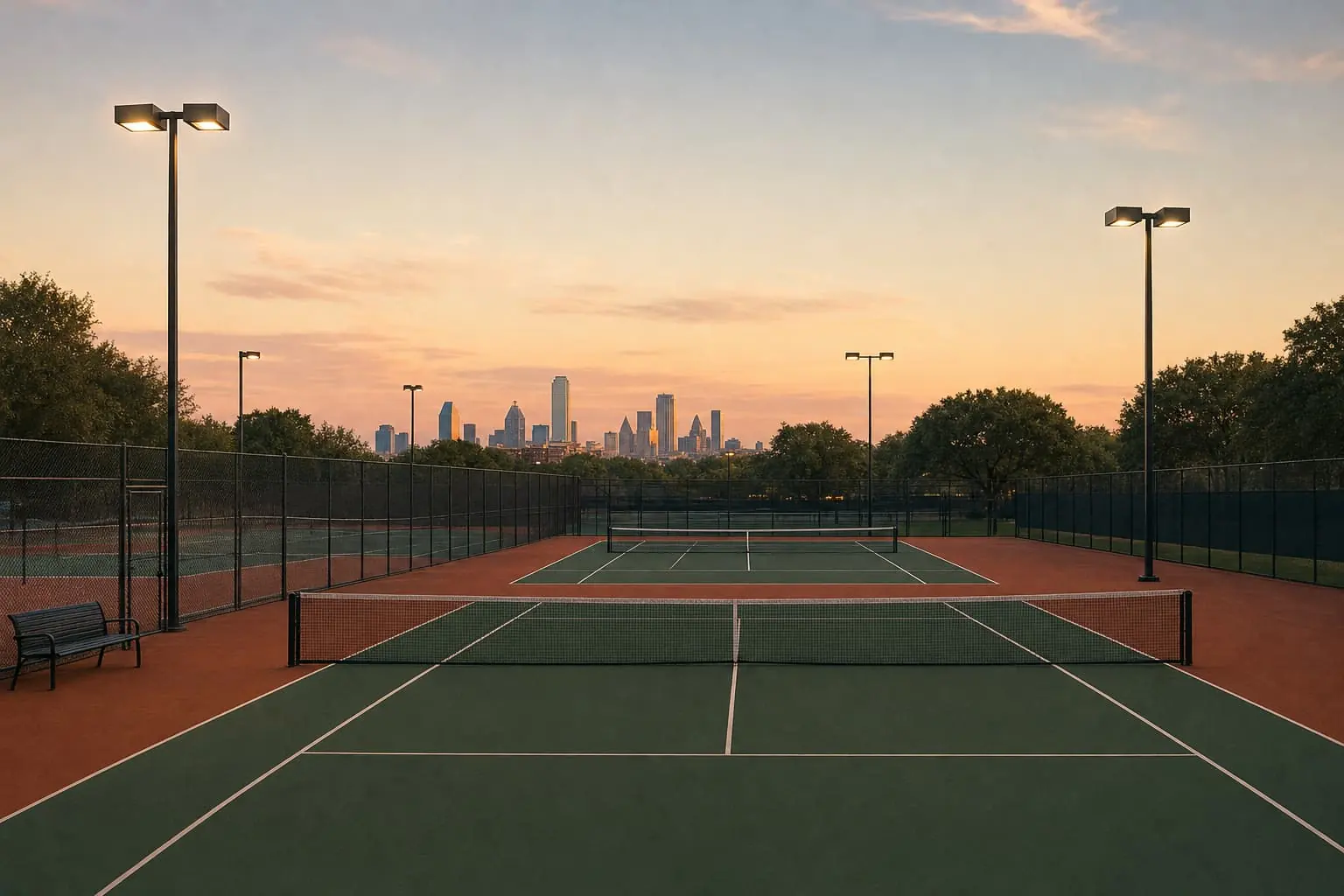
Dallas at a glance
| Ladders on Deuce | 1 |
| Active players (last 30 days) | 0 |
| Matches played (last 30 days) | 0 |
Ten players is enough to start a ladder. Below that we would rather tell you so than launch something that dies in three weeks.
Where you would play
Public tennis in Dallas means the four city-owned centers, each with a pro shop and each run by a contractor for the parks department. Past the city line, Plano, Richardson and Garland run public centers of their own, and Garland lists its free park courts one by one. A Dallas ladder match can go to any court the two of you can use, so the table covers all four cities.
Public tennis courts in and around Dallas, by operator
| Venue | City and address | Courts | Surface | Lights | Booking | Adult fee |
|---|---|---|---|---|---|---|
| Fretz Tennis Center | Dallas, 6998 Belt Line Road | 12 | Hard | Yes | Online, a day ahead, 90 minutes | Not stated by the operator |
| Samuell Grand Tennis Center | Dallas, 6220 E. Grand Avenue | 16 | Not stated | Yes | A day ahead, 90 minutes | Not stated by the operator |
| L.B. Houston Tennis Center | Dallas, 11225 Luna Road | 8 or 16 | Not stated | Yes | A day ahead, 90 minutes | Not stated by the operator |
| Kiest Tennis Center | Dallas, 2324 W. Kiest Boulevard | 16 | Hard | Not stated | Not stated | $3.25 for 90 minutes |
| High Point Tennis Center | Plano, High Point Park | 21 | Not stated | Yes | Two days ahead, 90 minutes | $4.00 resident, $5.50 non-resident, plus tax |
| Huffhines Tennis Center | Richardson, 1601 Syracuse Drive | 10 | Not stated | Yes | By phone, a day ahead | $3.50 for 90 minutes |
| Bob Day Tennis Center | Garland, 1801 TX-66 | 12 | Not stated | Yes | Reservations taken | Fee charged, amount not stated |
| Bradfield Park | Garland, 1220 Castle Drive | 2 | Not stated | Yes | First come, first served | Free |
| Cullom | Garland, 1310 Travis Street | 2 | Not stated | Yes | First come, first served | Free |
| Winters Park | Garland, 1330 Spring Creek Drive | 2 | Not stated | Yes | First come, first served | Free |
| Groves | Garland, 1510 Bobbie Lane | 2 | Not stated | No | First come, first served | Free |
"Not stated" means the operator's page doesn't say. Fees are per player, for one adult. Court counts are the operator's own, and at L.B. Houston the city's page says 16 lit courts while the operator's page shows 8 tennis courts beside its pickleball courts. We checked every row against the operator's page on October 17, 2026.
Of the posted prices, Kiest's is the lowest and Garland's park courts cost nothing. A ladder match can be played in any of these cities, so a Plano or Garland court counts the same as a Dallas one. The sections below go operator by operator, starting with Dallas.
The four Dallas tennis centers
The city owns the centers and contracts out the running of them. Impact Activities runs Fretz on Belt Line Road, L.B. Houston in northwest Dallas and Samuell Grand near White Rock Lake. The Kiest Tennis Center sits across from Kiest Park in Oak Cliff. The parks department's tennis page still lists a fifth center, Fair Oaks, but the city's 2022 briefing to its park board named only these four.
At the three Impact centers you reserve a court a day ahead and get 90 minutes for general play. Fretz asks you to reserve online. None of the three posts its per-player court fee, so ask when you book: Fretz is at (469) 372-6587, Samuell Grand at (469) 250-7887 and L.B. Houston at (972) 654-2844.
Regulars can skip the per-visit fee. Impact Activities sells a $25 monthly membership, plus a $69.99 initiation fee, that includes 90 minutes of free court time a day at any of its centers. It also lets you book up to eight days out instead of one. A guest you bring still pays a share of the court fee.
Fretz has 12 tennis courts beside 12 pickleball courts and stays open until 10 p.m. on weekdays. Samuell Grand, with 16 tennis courts, closes an hour earlier. Both open at 8 a.m. every day.
Kiest is the one center with a posted price, $3.25 a player for 90 minutes, on 16 hard courts. Its pages give no booking window, so call 972-213-0435. Plan around the midday break: on weekdays it closes from 1 to 3 p.m., then stays open until 9. Weekends run 9 a.m. to 6 p.m.
Neighborhood park courts in Dallas
The parks department's facility pages list a tennis court at more than 70 neighborhood parks, from Glencoe Park on Martel Avenue to Kidd Springs and Reverchon. Those pages give no court count and no booking terms, so the table leaves them out. City parks close from 11 p.m. to 5 a.m.
Plano: High Point Tennis Center
High Point is a City of Plano facility with 21 lit outdoor courts. You book up to two days ahead, for 90 minutes, and you can hold one reservation at a time. Every player on the court pays: $4.00 plus tax for a Plano resident and $5.50 plus tax for anyone else. Arrive on time, because an unclaimed court is released after 15 minutes.
An annual court pass costs $150 plus tax for a resident and $230 plus tax for a non-resident. From April through September the courts open at 7:30 a.m. and close at 10 p.m. Monday to Thursday.
Richardson: Huffhines and the park courts
Huffhines Tennis Center has ten lit courts at $3.50 a player for 90 minutes. To book, call 972-744-7870 the day before. When requests pile up, Richardson residents get first pick. The center opens at 8 a.m. daily and closes at 9 p.m. Monday to Thursday.
Richardson also has 22 park courts, first come, first served. The lit ones are at Heights, Cottonwood, Mimosa, Woodland, Custer, Terrace and Mark Twain parks, and a push button turns the lights on from dusk to 10:30 p.m.
Garland: Bob Day and the park courts
Garland's Bob Day Tennis Center, on Highway 66, has 12 lit courts and takes reservations. Impact Activities runs it and opens it at 7:30 a.m. every day. The city says a fee applies but doesn't print it; the center's number is (972) 205-2977. The 13 courts at Rick Oden Park are closed for renovation. The courts at Garland's four parks in the table cost nothing and run first come, first served from 6 a.m. to 10 p.m.
When you can play
In Dallas the hour you book matters almost as much as the court. Tennis here runs all year, and summer, not winter, is the hard season. The figures below are NOAA's 1991 to 2020 normals for Dallas Love Field.
| Months | Normal high | Normal low | Days at 90°F or more | Days at 100°F or more | What it means for a match |
|---|---|---|---|---|---|
| December to February | 58 to 62°F | 38 to 42°F | Under 1 in all | None | Good at midday, cool after dark |
| March to May | 70 to 85°F | 49 to 66°F | About 9 in all | Under 1 in all | Prime season |
| June to August | 93 to 97°F | 74 to 78°F | About 79 in all | About 20 in all | Play at opening time or under lights |
| September to November | 68 to 90°F | 48 to 70°F | About 20 in all | About 2 in all | September runs hot, then prime |
July and August are the worst of it. Each month averages a high of about 97°F and about 28 days at 90°F or more, and August adds about ten days at 100°F. Nights barely help: the normal low in both months is close to 78°F.
An indoor court would help in August. We looked for one and came up empty: no indoor club here publishes terms for a casual booking, so this page lists none.
Rain comes in every month. October is the wettest at about 4.8 inches, May is close behind, and July is the driest. If a storm takes out your booking, the 30-day play window leaves room to play the match another day.
How a ladder works here
Deuce's rules are the same everywhere. In Dallas, the thing to plan around is the 90-minute booking you get at a city center, at High Point and at Huffhines. Best of three sets can run past that. Deuce records six formats, among them one set with a tiebreak at 6-6, an eight-game pro set and best of three with a match tiebreak to 10 in place of the third set. Agree on one that fits the booking before you walk on. The Dallas ladder accepts all six.
From June through August, take the first slot of the day or the last one under the lights. High Point and Bob Day open at 7:30 a.m., and Fretz and Samuell Grand at 8. The challenger books the court unless you agree otherwise. When you accept, agree on a court and a time, and decide who pays the fee.
The mechanics
These are the defaults. An organizer can change the challenge range, both windows and the rematch cooldown. The first challenge, the absence rule and the inactivity schedule are fixed.
| Rule | Default |
|---|---|
| Challenge range | Five rungs up. Rung 6 may challenge rung 1 |
| Response window | 5 days |
| Play window | 30 days from acceptance |
| First challenge | One unrestricted challenge inside your own level band. Always on |
| Rematch cooldown | 14 days. Playing someone else does not shorten it |
| Absence | Up to 21 days. You keep your rung and cannot be challenged |
| Inactivity | Points decay every 30 days without a played match. Your rung is released at 180 days and you are withdrawn at 365 |
In Dallas the rule to know is the absence. If you leave town in August or stop playing in the heat, mark yourself absent. You keep your rung, nobody can challenge you, and the decay clock stops. A standard absence lasts up to 21 days, and there is no limit on how many you take. For longer, an extended absence runs up to six months, needs a written reason and goes to your organizer. The rules page has the detail, scoring explains how a score gets confirmed, and the glossary defines rung and level band.
Levels and where you start
Dallas sorts its tennis by NTRP. USTA Texas runs its adult leagues at NTRP levels from 2.5 to 5.0, and the Dallas Tennis Association asks a player with no rating to self-rate from the NTRP guidelines. Rival also registers you by NTRP level, with Dallas ladders from 2.5 up to 4.5 for men and 4.0 for women.
On Deuce you don't need a rating, though one helps. Give us an NTRP, UTR, WTN or club level if you have it. If not, describe your game and we'll place you, using two rules.
- A close call goes up. Between 3.5 and 4.0? You start at 4.0. A player placed too low collects easy wins and skews the ladder for everyone below.
- Your first match settles it. Your first challenge can go to anyone in your level band, so a wrong placement lasts one result.
The rating conversion table lines NTRP up against UTR and WTN. For what each NTRP level looks like on court, see the NTRP rating chart.
How competitive tennis is organized in Dallas
Besides Deuce, we found five organizations running competitive tennis in Dallas. Three are team leagues: USTA leagues through the Dallas Tennis Association, plus two doubles leagues that draw teams from the same public centers. For singles there's a flex league and a seasonal ladder. We describe each from its own pages as of October 17, 2026.
USTA leagues through the Dallas Tennis Association
The association dates from the 1930s and runs USTA adult leagues all year. To join one, make a free USTA account, self-rate if you have no NTRP rating, then find a team through its captain. The association's league page lists teams looking for players. This fall's men's 65 and over league started on October 5, and a tri-level weekend event runs December 3 to 6.
Doubles leagues: TCD and Metro
Tennis Competitors of Dallas runs doubles across the metroplex, with ladies, Love-50, Love-60, Love-70 and mixed divisions. The Metroplex Tennis League is a women's weekend doubles league. Both field teams based at local tennis facilities, and Metro's women's flights include teams from Fretz, Kiest, L.B. Houston, Samuell Grand, Huffhines and High Point.
Singles players who want a season with an end date have the Dallas Tennis League, the Tennis League Network's flex league for the city. You join a division, then set up each match and court yourself with the players in it, and the season ends in playoffs for players with three to five wins. Its next season runs October 20 to December 13. It costs $29.95 before kickoff and $34.95 at full price.
Rival Tennis Ladder runs Dallas singles and doubles ladders in four 10-week seasons a year, each ending in a tournament. Its fall season runs through November 29, you can join at any point, and Rival is waiving its fees in Dallas for now. How Rival compares with Deuce sets the rules and scoring side by side.
The flex league and Rival both run on seasons, while a Deuce ladder keeps going without one. You challenge when you're ready, the other player gets five days to answer, and an accepted match has 30 days to get played. Those windows keep a challenge moving. They don't book a court for you, and nothing can promise that the match gets played.
Deuce won't suit every Dallas player. The city ladder is singles only, so if you play doubles, TCD, Metro or a USTA team will serve you better. A USTA league also gives you a captain and a weekly lineup, which a ladder doesn't.
Questions
Short answers, each checked against its source on October 17, 2026.
Is there a tennis ladder in Dallas?
Yes. Deuce runs the Dallas singles ladder, open-ended and free to join. Rival Tennis Ladder runs seasonal singles and doubles ladders in Dallas, and it currently charges nothing there. The Dallas Tennis League is a flex league rather than a ladder, and its next season starts October 20.
Are tennis courts free in Dallas?
Not at the city's four tennis centers. Kiest charges $3.25 a player for 90 minutes. Impact Activities, which runs the other three, sells a $25 monthly membership with 90 minutes a day included. Dallas lists courts at more than 70 parks but publishes no terms for them. Garland's park courts in the table are free.
How do I reserve a court at a Dallas tennis center?
At Fretz, L.B. Houston and Samuell Grand you book a day ahead and get 90 minutes, and Fretz asks you to reserve online. Impact Activities members can book up to eight days out. Kiest's pages give no window, so call 972-213-0435. Outside Dallas, High Point books two days ahead, and Huffhines takes calls at 972-744-7870 the day before.
Which courts have lights?
Fretz, L.B. Houston and Samuell Grand are lit, and so are all 21 courts at High Point, the ten at Huffhines and the twelve at Bob Day. Kiest's pages don't say. Richardson's lit park courts run on a push button until 10:30 p.m., and Dallas parks close at 11 p.m.
When is it too hot to play?
From June through August, Love Field averages about 79 days at 90°F or more and about 20 days at 100°F or more, with August the worst. Book the first slot of the morning or play under the lights. March to May and October to November are the prime months.
What rating do Dallas players use?
NTRP. USTA Texas sets its league levels by NTRP, and the Dallas Tennis Association asks new players to rate themselves. Rival's Dallas ladders also run by NTRP level. Deuce takes NTRP, UTR, WTN or a club level, but you can join without one, and your first challenge corrects a placement that's off.
Can I play in Plano, Richardson or Garland?
Yes. Nothing ties the Dallas ladder to city courts: you and your opponent pick any court you can both use. High Point in Plano charges non-residents $5.50 plus tax. Huffhines in Richardson favors residents when bookings are tight. Garland's park courts are free, first come, first served.
How is a ladder different from a league?
A USTA league puts you on a team with a captain and a weekly lineup, and a flex league drops you into a division for one season. On a ladder you hold a rung and decide who to challenge and when, inside a response window and a play window. How it works has the full picture.
What does it cost to join?
Nothing. Deuce Ladder is free for players right now. Court time is the cost: $3.25 a player at Kiest, $3.50 at Huffhines, $4.00 to $5.50 plus tax at High Point, or nothing at Garland's park courts. Browse Discover, or see what players get.
How do I start a ladder in Dallas?
Apply as an organizer. You need ten players you can name, and a group that already plays at one center is the easiest place to find them. Every application is reviewed before the ladder opens. The steps are below and on the organizers page.
Start a ladder in Dallas
The city ladder is for singles players from anywhere in Dallas. A smaller ladder can work better, because it settles the court question at the start. Kiest regulars, or a group of Impact members, share one booking system and one fee. A workplace group or a USTA team that wants singles between league matches is another good start.
The application is ten questions and takes about five minutes. Someone at Deuce reads each one and writes back if anything is unclear. Once approved, the ladder is live, and players can join and challenge that day.
You need ten players you can name. Twelve or more is better, because a small group keeps drawing the same opponents. With fewer than ten, apply anyway, and we'll say so if the group is too thin to work.
Nothing imports from a spreadsheet or another ladder site. Invite your players once the ladder is approved, and let each one's unrestricted first challenge sort out the order.
Sources and last verified
- Dallas Park and Recreation: Tennis, Park Rules and Ordinances, and the facility pages for Fretz, Kiest, L.B. Houston, Samuell Grand and Glencoe Park
- City of Dallas Park and Recreation Board: Tennis Centers Operational Update, March 10, 2022
- Impact Activities: Fretz, Samuell Grand, L.B. Houston, Bob Day, Membership and External Leagues
- Kiest Tennis Center
- High Point Tennis Center, City of Plano: Fees, Rentals and Passes, About and Metroplex League Play
- City of Richardson: Huffhines Tennis Center
- City of Garland: Tennis and Pickleball
- Dallas Tennis Association: Home, Adult Leagues and Who We Are
- Tennis Competitors of Dallas and Metroplex Tennis League
- Dallas Tennis League: How a season runs
- Rival Tennis Ladder: Tennis Ladder in Dallas
- U.S. Monthly Climate Normals, 1991 to 2020, NOAA National Centers for Environmental Information, station Dallas Love Field (USW00013960)
Last verified: October 2026.