
Cities
Tennis ladders in London
The London singles ladder is open on Deuce, and anyone can join. Here is where you would play, what a park court costs, how the booking window works, and how the ladder works.
London at a glance
| Ladders on Deuce | 2 |
| Active players (last 30 days) | 0 |
| Matches played (last 30 days) | 0 |
Ten players is enough to start a ladder. Below that we would rather tell you so than launch something that dies in three weeks.
Where you would play
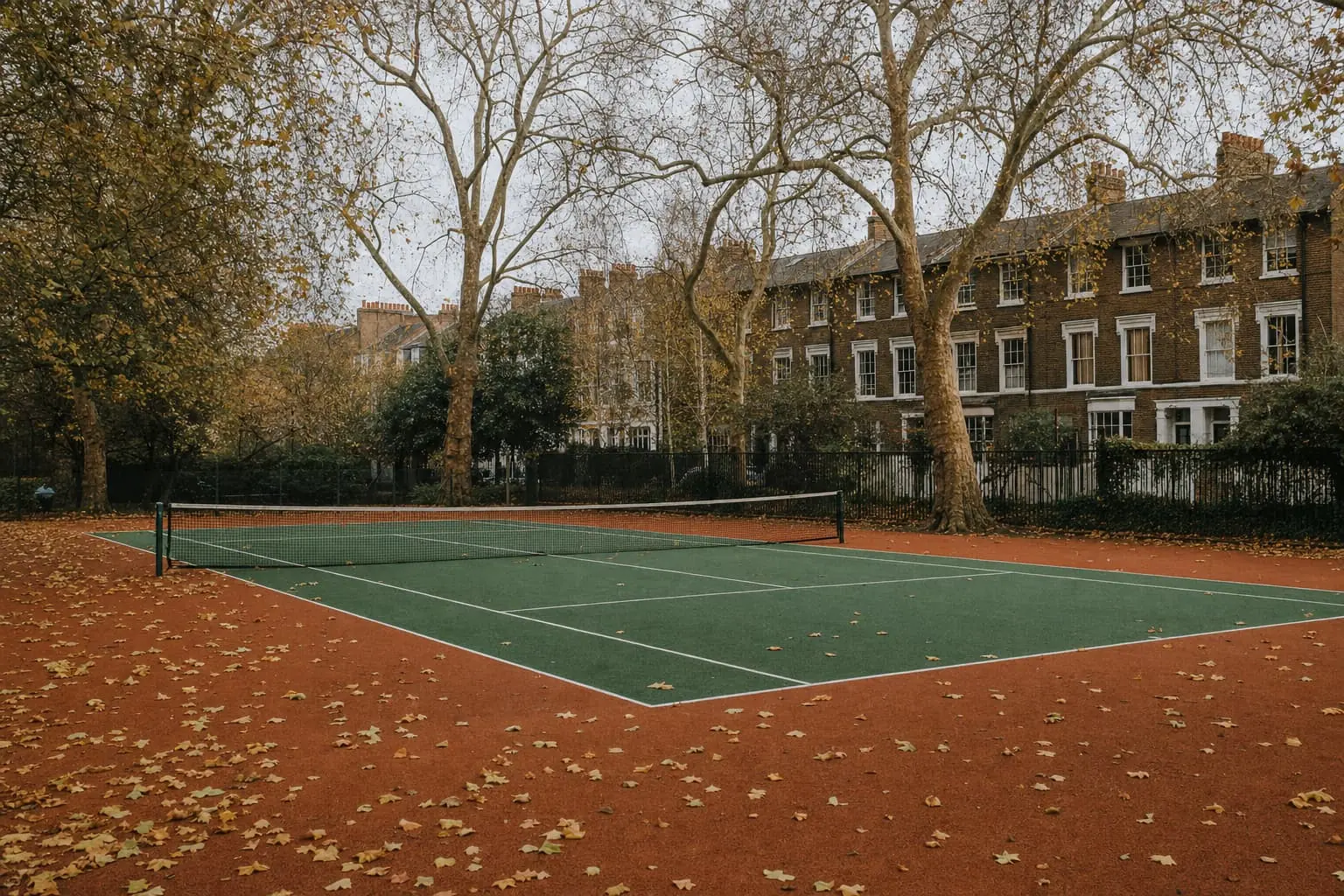
London has more than a thousand outdoor courts.
Park courts
Most are pay-and-play through ClubSpark under the LTA's park tennis scheme. One account works across most boroughs, though a few councils still run their own portals.
Rates are set per borough, so check the borough's own booking page for the price before you agree a match there.
Booking rules that shape a ladder. Each borough sets how far ahead its courts open, when new slots are released, what counts as peak and whether there is a daily booking limit. Read your borough's rules before you agree a date, because they decide who in a match should book.
Floodlighting is the constraint that matters. Most park sites are unlit. In a London winter that means no midweek evening tennis at all outside the lit sites, and the lit ones are heavily contested. Before you set a season, list the floodlit courts within reach of your players.
Clubs
London's private clubs are excellent and mostly hard to join. Community clubs are a different matter: many have floodlit all-weather courts, reasonable subscriptions, and existing box leagues. If your ladder is club-based, the winter problem largely disappears.
When you can play
London plays year-round on paper and about seven months in practice.
April to September
is the outdoor season. Long evenings, and from May to August you can start a match at seven and finish in daylight.
October to March
is where a London ladder either has floodlights or has weekends only. Sunset in December is before four in the afternoon. Rain is a steady nuisance rather than a dramatic one, and it moves matches rather than cancelling seasons.
Recommended season length: ten weeks, starting in late April
A winter ladder in London is possible, but only if it is built on a floodlit or indoor venue list and the copy says so.
How a ladder works here
The shared mechanics are the same in every city. What changes here is the format, and it changes because of the court slot.
Park courts are sold by the hour, and some boroughs sell thirty-minute blocks.
- Two hours booked. Best of three sets with a match tiebreak to ten in the third. The right default in summer.
- One hour booked. An eight-game pro set, or short sets to four. The right default in winter, when court time is scarce and light is scarcer.
The mechanics
These are the defaults. An organizer can change most of them when the ladder is set up.
| Rule | Default |
|---|---|
| Challenge range | Five rungs up. Rung 6 may challenge rung 1 |
| Response window | 5 days |
| Play window | 30 days from acceptance |
| First challenge | One unrestricted challenge inside your own level band. Always on |
| Rematch cooldown | 14 days. Playing someone else does not shorten it |
| Absence | Up to 21 days. You keep your rung and cannot be challenged |
| Inactivity | Points decay every 30 days without a played match. Your rung is released at 180 days and you are withdrawn at 365 |
The seven-day booking window is the real constraint here, not the 30-day play window. Whoever issues the challenge should book first and offer the slot. Agreeing a date and then hunting for a court is how a London challenge quietly expires.
Full ruleset at /rules. Scoring and verification at /scoring.
Levels and where you start
Britain runs on the ITF World Tennis Number, and most club players in London have one or can get one free through an LTA account. Some players still describe themselves in club terms (fourth team, second team) and that is a usable signal too.
WTN runs the opposite way to NTRP: lower is stronger.
Deuce accepts whatever you have: NTRP, UTR, WTN, LTA rating, ITN, a national federation ranking, or a club level. All of them are optional. If you have none, describe your game and the system places you.
Two rules to know before you sign up:
- Low confidence places you high, not low. When we are unsure, you start at the top of the plausible range, never the middle and never the bottom. An underplaced player gets easy matches, which is the fastest way to ruin a ladder for everyone else.
- Your first challenge fixes it. One unrestricted challenge anywhere inside your band, played once, corrects a bad placement in a single match.
How the rating systems compare across countries is at the conversion table. What each NTRP level looks like in a match is on the NTRP rating chart.
How competitive tennis is organized in London
London has more organized adult tennis than any city in this set, and almost none of it is a challenge ladder.
Box leagues
are the dominant format. Small groups of similar-ability players, everyone plays everyone, promotion and relegation between rounds. They run at borough level and inside clubs, and they work.
Club competition
covers internal leagues, matchplay and interclub teams for members.
Coaching operations
at park venues produce a large volume of social play.
Looking for someone to hit with
rather than a ladder opponent? Finding a tennis partner in London covers the LTA leagues, club social sessions and the hitting partners board, and how to book a park court with someone new.
What is missing
is player agency. In a box league you are given a group and told who to play. In a ladder you hold a rung and choose. That is the whole difference, and in a city with a thousand courts and a deep player base it is the only thing worth building.
Questions
Is there a tennis ladder in London?
Some clubs run internal ladders. The dominant public format is the box league, not a ladder. Deuce runs the London singles ladder. It is open-ended, and anyone can join.
What does a park court cost in London?
It depends on the borough. Each council sets its own park court rates, so check the borough's booking page for the current price before you agree a match.
How do I book a park court?
Most boroughs use ClubSpark under the LTA park tennis scheme, and one account works across them. A few councils run their own portals. How far ahead courts open varies by borough.
Can I play in winter?
On floodlit courts, yes. Most park sites are unlit, and December sunset is before four in the afternoon, so a winter ladder needs a floodlit or indoor venue list.
What is a WTN?
The ITF World Tennis Number, the rating British tennis runs on. Lower is stronger, which is the opposite of NTRP. It is free with an LTA account.
How is a ladder different from a box league?
A box league puts you in a group and tells you who to play. A ladder gives you a rung and lets you challenge the people above you.
What does it cost to join?
Nothing. Deuce Ladder is free for players right now. Court fees are separate and you pay them to the borough or your club.
How do I start one?
Below. You need ten players you can name.
Start a ladder in London
For a club pro, a volunteer captain, a company team, or one person whose group chat has outgrown itself.
The application is ten questions and takes about five minutes. We review it and get in touch only if something needs clarifying. Once it is approved, the ladder is live and players can join and challenge straight away.
There is no self-serve wizard: every application is reviewed before the ladder opens.
You need ten players you can name. Twelve or more is where a ladder becomes self-sustaining, because that is the point at which the same two people stop playing each other every week. Under ten, apply anyway: we will tell you so rather than launch something thin.
If you already run a ladder in a spreadsheet, there is no import: invite your players once the ladder is approved, and the unrestricted first challenge sorts the order in a round.