
Cities
Tennis ladders in Berlin
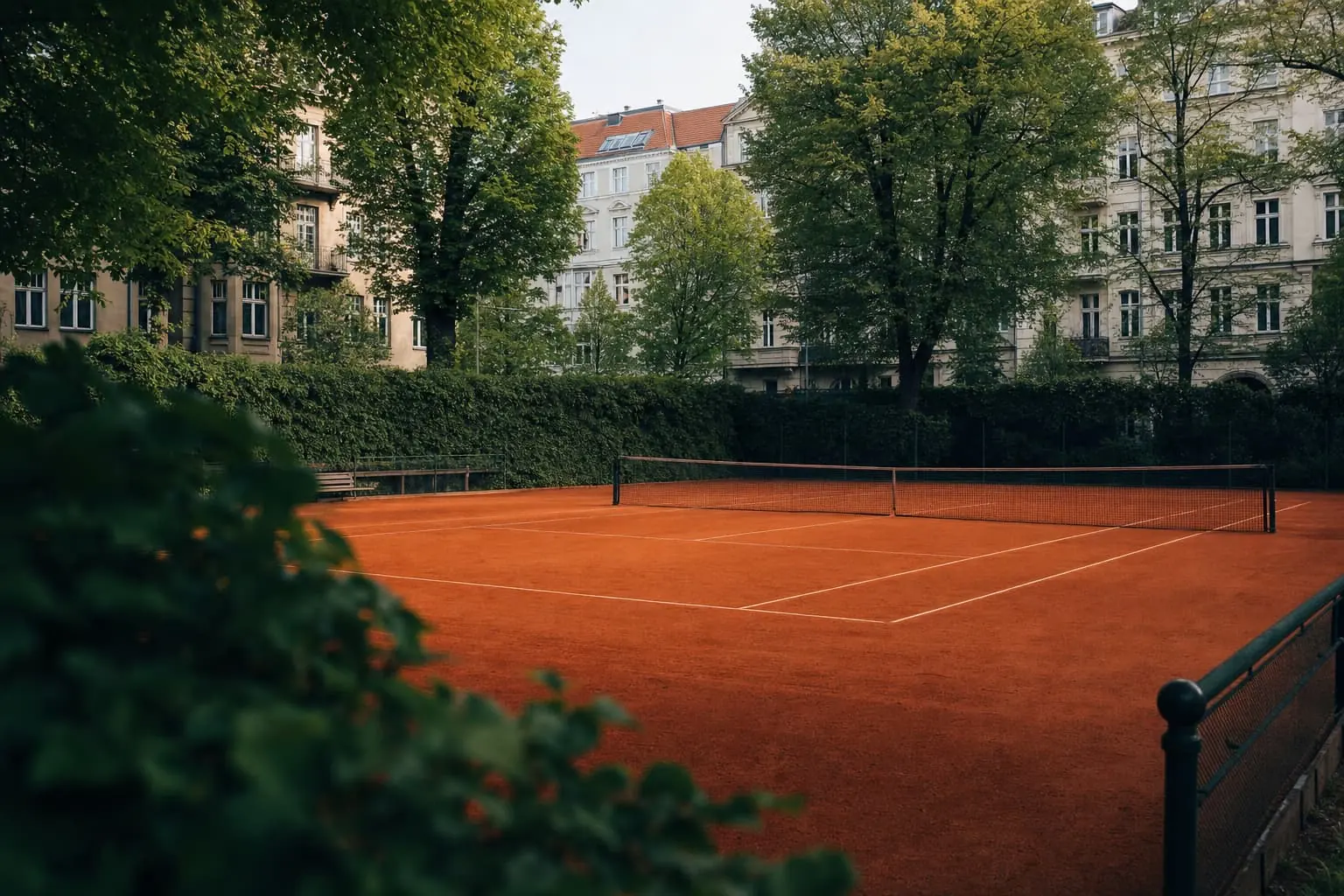
The Berlin singles ladder is open on Deuce, and it is free to join. You pick who you play, then book a court. Berlin tennis runs on club clay. At Treptower Teufel the outdoor courts open from early April to mid-October, and a guest pays €30 an hour. In winter, play moves into halls: Sportcenter Wittenau charges €27 to €33 an hour. The district of Charlottenburg-Wilmersdorf runs two free public courts on Harbigstraße.
Berlin at a glance
| Ladders on Deuce | 1 |
| Active players (last 30 days) | 0 |
| Matches played (last 30 days) | 0 |
Ten players is enough to start a ladder. Below that we would rather tell you so than launch something that dies in three weeks.
Where you would play
Berlin tennis runs through clubs, and the clubs run on clay.
Clubs
The club is the unit of German tennis. Most Berlin clubs have clay courts, an annual membership, a clubhouse and a place in the league structure. Members typically book courts through a club system at little or no additional cost, which makes a club-based ladder close to free to run.
Many clubs also sell court time to non-members, usually outside the evening hours members want.
Two published examples show the pattern. Treptower Teufel lets guests book outdoor clay on weekdays until 5pm and any time at weekends, through its eBuSy system, up to four days ahead on a weekday. BTC WISTA charges €15 an hour when you play with a member and €30 when only guests play, with guest slots on weekdays before 4pm or after 8pm.
Indoor halls
Indoor halls and air domes carry the winter. Court time is sold by the hour or as a fixed weekly slot for the whole season. Surfaces vary: some clubs cover clay courts with an air dome, others run hard, carpet or artificial grass.
A season slot means one court at the same hour every week. Tennisfreunde Berlin-Mitte, for example, sells its winter 2026/27 air dome slots for 22 weeks, from November 9, 2026 to April 11, 2027: €880 for a prime-time slot, €726 off-peak, up to four players, no membership required.
Public courts
Berlin has a thin public layer, and it is seasonal.
The district office of Charlottenburg-Wilmersdorf opens two courts at Harbigstraße 34 in Westend free of charge, from April 13 to September 30, 2026. You register on Wednesdays between 8am and 10am, for the current week and up to two weeks ahead, in person at Harbigstraße 40 or by phone. There are currently no toilets or changing rooms.
Berlin tennis venues
| Venue | Location | Courts | Surface | Non-members | Published rate |
|---|---|---|---|---|---|
| Treptower Teufel | Köpenicker Landstraße 186, Baumschulenweg | Outdoor clay, plus a 3-court indoor hall and an air dome | Clay outdoors, hard in the hall | Yes, online via eBuSy | €30 per hour outdoors. Winter 2026/27 hall €32 to €36, air dome €24 to €29 |
| Sportcenter Wittenau | Wittenauer Straße 82 to 86, Reinickendorf | Convertible-roof hall | Swing floor (similar to Rebound Ace) | Yes, online, pay on site | Summer €25 to €31, winter €27 to €33, up to four players |
| LTTC "Rot-Weiß" Berlin | Gottfried-von-Cramm-Weg 47 to 55, Grunewald | 8 in winter: 6 in air halls, 2 in a permanent hall | Clay in the air halls, DecoTurf in the hall | Yes, online | Winter 2026/27 rate not yet published |
| Tennisfreunde Berlin-Mitte | Boyenstraße 22, Mitte | 3 in a winter air dome | Artificial grass | Yes, season slots | €880 prime, €726 off-peak per 22-week slot |
| BTC WISTA | Wilhelm-Ostwald-Straße 4, 12489 | Winter hall over courts 5 and 6 | RedCourt in the hall | Yes, restricted hours | €15 with a member, €30 guests only |
| OSC Berlin | Vorarlberger Damm 37, 12157 | 8 outdoor, plus a 3-court air hall | 5 clay, 3 Tennisforce | Online booking listed | Not published |
| Grunewald Tennisclub | Flinsberger Platz, 14193 | 13, five coverable with air domes | Not stated | Members' club | Not published |
| SC Brandenburg | Harbigstraße, 14055 | 10 outdoor, plus a three-court hall | Clay outdoors | Not stated | Not published |
| Preussenpark | Kamenzer Damm 34, 12249 | 8: 4 indoor, 4 outdoor | Not stated | Not stated | Not published |
| TCW Sports | Roelckestraße 106, 13088 | 5 hall courts | Carpet with rubber granulate | Not stated | Not published |
| SV Berliner Brauereien | Volkspark Prenzlauer Berg | 6, floodlit | Clay | No, members only | Not applicable |
| Harbigstraße public courts | Harbigstraße 34, Westend | 2 | Not stated | Yes, free, register weekly | Free, April 13 to September 30, 2026 |
When you can play
Berlin has the sharpest surface-based season split in this set.
April to mid-October
is the outdoor clay season. Treptower Teufel opened its 2026 outdoor courts in early April and closes them in mid-October, depending on the weather. The free district courts at Harbigstraße run from April 13 to September 30.
October to April
is indoor. Air domes go up and hall season prices apply: Sportcenter Wittenau switches to winter rates on October 1, and the Tennisfreunde Berlin-Mitte dome runs from November 9 to April 11. Weekly slots are sold for the whole winter, so casual availability is limited.
Recommended season length: ten weeks, starting in May
A Berlin ladder should be an outdoor clay season by default. A winter ladder is possible but it requires indoor slots secured in advance, and that is an organizer's job done in September, not in December.
How a ladder works here
The shared mechanics are the same in every city. What changes here is the format, and it changes because of the court slot.
Court time is generally booked in one-hour or ninety-minute blocks, and clay is slower than hard court, which matters more than people expect.
- Ninety minutes or two hours. Best of three sets with a match tiebreak to ten in the third. The clay default.
- One hour. An eight-game pro set, or short sets to four. Be realistic: a competitive three-set clay match does not fit in an hour.
The mechanics
These are the defaults. An organizer can change most of them when the ladder is set up.
| Rule | Default |
|---|---|
| Challenge range | Five rungs up. Rung 6 may challenge rung 1 |
| Response window | 5 days |
| Play window | 30 days from acceptance |
| First challenge | One unrestricted challenge inside your own level band. Always on |
| Rematch cooldown | 14 days. Playing someone else does not shorten it |
| Absence | Up to 21 days. You keep your rung and cannot be challenged |
| Inactivity | Points decay every 30 days without a played match. Your rung is released at 180 days and you are withdrawn at 365 |
Keep the full play window if the ladder runs indoors. Winter hall slots are booked far ahead, so do not shorten the thirty-day default for a winter season.
Also account for the clay: rain leaves courts unplayable for longer than it does on hard court, and a rained-off match should not consume the window.
Full ruleset at /rules. Scoring and verification at /scoring.
Levels and where you start
Germany runs on the LK (Leistungsklasse), the national rating of the German Tennis Federation (DTB). Most registered club players carry one, and it is a genuine advantage for seeding a ladder here.
The scale runs from LK 1.0, the best, to LK 25.0, the lowest. The DTB recalculates it once a week, and the current weekly system has been in place since October 1, 2020. Any DTB club member from the under-11 age group up can hold one. Only wins count toward it.
Deuce accepts whatever you have: NTRP, UTR, WTN, LTA rating, ITN, a national federation ranking such as the LK, or a club level. All of them are optional. If you have none, describe your game and the system places you.
Two rules to know before you sign up:
- Low confidence places you high, not low. When we are unsure, you start at the top of the plausible range, never the middle and never the bottom. An underplaced player gets easy matches, which is the fastest way to ruin a ladder for everyone else.
- Your first challenge fixes it. One unrestricted challenge anywhere inside your band, played once, corrects a bad placement in a single match.
How the rating systems compare across countries is at the conversion table. What each NTRP level looks like in a match is on the NTRP rating chart.
How competitive tennis is organized in Berlin
Competitive amateur tennis in Berlin is organized through clubs and the regional federation.
Team competition (Medenspiele)
is the dominant format. The Tennis-Verband Berlin-Brandenburg (TVBB) runs it through its nuLiga portal, which lists a summer 2026 round, a winter 2026/2027 round and a separate mixed and doubles round. Clubs enter teams by age group and gender. VfV Spandau, for example, entered eight teams in summer 2026, with fixtures from May 2 to July 26.
The LK
turns those team matches, and approved tournaments, into an individual rating that updates weekly.
Club internal competition
covers club championships and, at some clubs, internal ladders.
What is missing
is an open individual format. Team play gives you a fixed fixture list and a captain's selection. Nothing in the federation structure lets one player choose an opponent and arrange a match on their own schedule. A ladder does exactly that.
Questions
Is there a tennis ladder in Berlin?
Some clubs run internal ladders for their own members, and the federation runs team competition, but there is no open city-wide ladder outside Deuce. The Deuce Berlin singles ladder is open-ended and free to join. You choose who to challenge and agree the court and time yourselves.
Can I play tennis in Berlin without joining a club?
Yes. Several clubs sell guest hours: Treptower Teufel charges €30 an hour for outdoor clay, and BTC WISTA charges €15 when you play with a member. Sportcenter Wittenau needs no membership at all. The district also runs two free public courts at Harbigstraße 34 from April to September.
What does an indoor court cost in Berlin in winter?
It depends on the hall and the hour. For winter 2026/27, Treptower Teufel charges guests €32 to €36 an hour in its hall and €24 to €29 in its air dome. Sportcenter Wittenau charges €27 to €33. Season slots at the Tennisfreunde Berlin-Mitte dome cost €726 to €880.
When is the outdoor clay season in Berlin?
Roughly April to mid-October. Treptower Teufel opened its outdoor courts in early April 2026 and closes them in mid-October, depending on the weather. The free district courts at Harbigstraße run from April 13 to September 30. Outside that window, tennis in Berlin moves into halls and air domes.
What is the LK?
The Leistungsklasse, the German Tennis Federation's national rating. It runs from LK 1.0, the best, to LK 25.0, the lowest, and is recalculated every week. Only wins count. Most registered club players carry one, which makes seeding a Berlin ladder straightforward.
Does clay change the format?
Yes. Points are longer on clay, so matches take longer. Book ninety minutes or two hours for a best-of-three with a match tiebreak, not one hour. If you only have an hour, play an eight-game pro set or short sets to four instead.
How is a ladder different from Medenspiele?
Medenspiele are team matches run by the TVBB: you play for a club team, in a division, on a fixed fixture date. A ladder is individual. You hold a rung, choose who to challenge, and agree a date with your opponent. Results earn Deuce Points that order the standings.
What does it cost to join?
Nothing. Deuce Ladder is free for players right now. What you pay for is the court: a club membership, a guest fee, or a hall booking, paid to the club or hall directly. Deuce does not sell court time.
How do I start one?
Apply through the organizer form below. The application is ten questions and takes about five minutes. You need ten players you can name, and twelve or more is where a ladder sustains itself. Once Deuce approves it, the ladder is live and players can challenge.
Start a ladder in Berlin
For a club pro, a volunteer captain, a company team, or one person whose group chat has outgrown itself.
The application is ten questions and takes about five minutes. We review it and get in touch only if something needs clarifying. Once it is approved, the ladder is live and players can join and challenge straight away.
There is no self-serve wizard: every application is reviewed before the ladder opens.
You need ten players you can name. Twelve or more is where a ladder becomes self-sustaining, because that is the point at which the same two people stop playing each other every week. Under ten, apply anyway: we will tell you so rather than launch something thin.
If you already run a ladder in a spreadsheet, there is no import: invite your players once the ladder is approved, and the unrestricted first challenge sorts the order in a round.
Sources and last verified
- Guest court booking and outdoor season, Treptower Teufel
- Indoor court rates, winter 2026/27, Treptower Teufel
- Tennis without membership, Sportcenter Wittenau
- Winter subscription 2026/27, Tennisfreunde Berlin-Mitte
- Playing as a guest, Berliner Tennis Club WISTA
- Indoor tennis, LTTC "Rot-Weiß" Berlin
- Tennis facility, OSC Berlin
- Club home, SV Berliner Brauereien
- Harbigstraße courts reopen in April, Bezirksamt Charlottenburg-Wilmersdorf
- Playing tennis in Berlin, visitBerlin
- Leistungsklasse (LK), Deutscher Tennis Bund
- nuLiga TVBB, Tennis-Verband Berlin-Brandenburg
- TVBB fixtures, summer 2026, VfV Spandau
Last verified: September 2026.