
Cities
Tennis ladders in Beijing
The Beijing singles ladder on Deuce Ladder is open, free to join, and run in English. Beijing has 3,380 standard tennis courts, more than 800 of them indoor, according to figures Beijing Youth Daily reported in September 2026. Courts are busy: in summer 2024, every outdoor slot after 7pm at Chaoyang Park Tennis Center was booked, and peak outdoor time there was reported at 140 yuan an hour.
Beijing at a glance
| Ladders on Deuce | 1 |
| Active players (last 30 days) | 0 |
| Matches played (last 30 days) | 0 |
Ten players is enough to start a ladder. Below that we would rather tell you so than launch something that dies in three weeks.
Where you would play
Beijing's court stock is large and heavily seasonal.
The city has 3,380 standard tennis courts, according to the China Tennis Development Basic Data 2025 as reported by Beijing Youth Daily (北京青年报). More than 800 are indoor courts and more than 2,500 are outdoor public courts. The same report counts 1.34 million people who play regularly. Chaoyang District alone has 763 courts.
Public and commercial courts
Municipal sports centers, park courts and commercial centers are spread across the city, with the international community concentrated around Chaoyang, Shunyi and Haidian. Booking runs through venue systems and WeChat mini-programs, in Chinese.
Chaoyang Park Tennis Center (朝阳公园网球中心) shows how tight the popular courts are. In April 2024 it raised its peak outdoor rate from 120 to 140 yuan an hour, and its center court from 320 to 360 yuan. Peak means weekdays after 4pm plus weekends and public holidays. Its staff said the popular slots open three days ahead, at 6am, and must be grabbed. Those are the latest published figures we could find, reported in August 2024. Check the current rate on the venue's mini-program before you book.
Compound, club and school courts
Villa compounds in Shunyi, the international schools and the established clubs hold a large share of the courts the international community actually uses.
Indoor courts
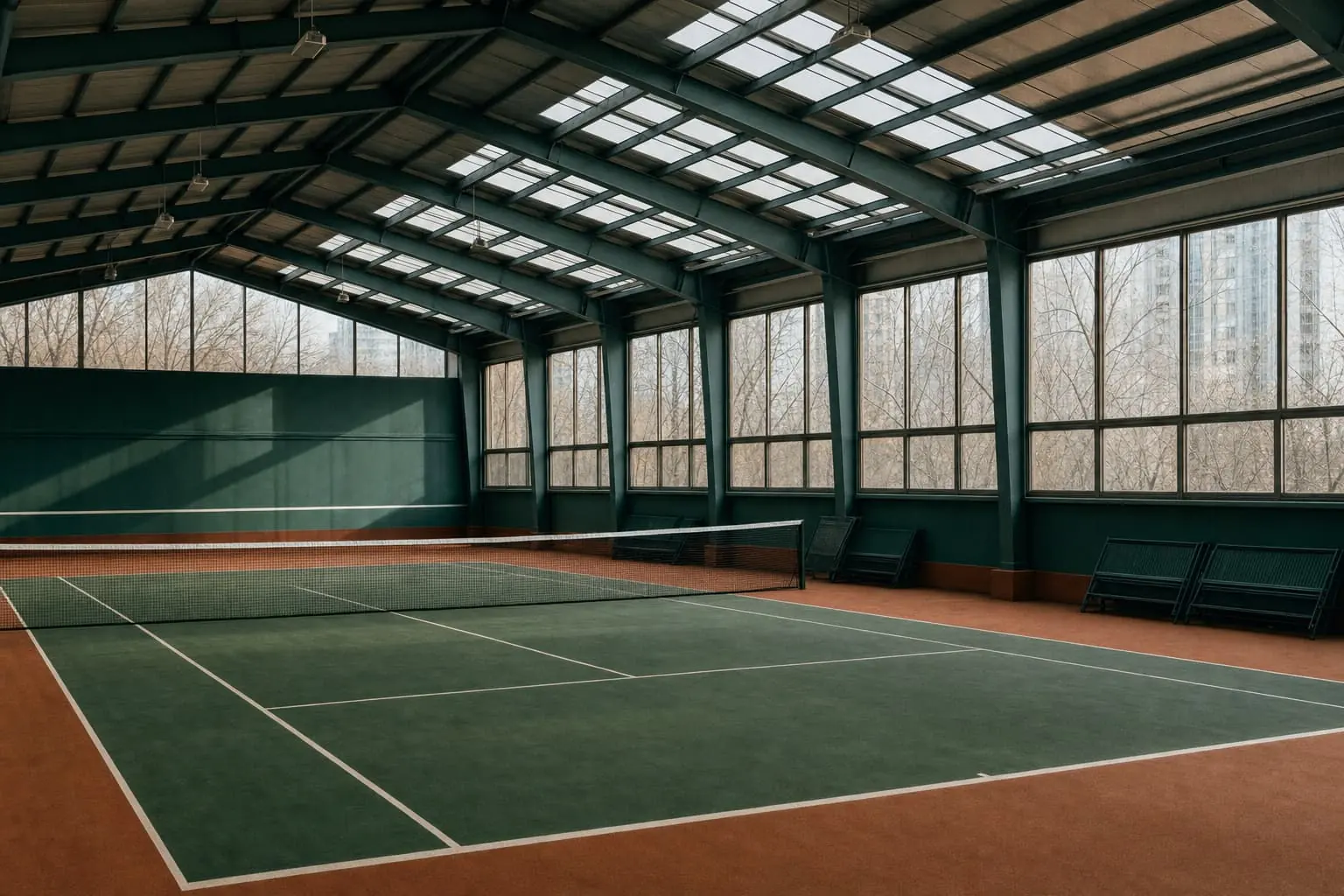
Not optional here. Beijing winters end outdoor tennis for months, and indoor halls and inflatable domes are the only way a ladder survives from November to March. The city counts more than 800 indoor courts. They cost more than outdoor courts and they fill up.
Beijing tennis venues
| Venue | District | Courts | Indoor | How it is booked | Note |
|---|---|---|---|---|---|
| China National Tennis Center (国家网球中心) | Chaoyang, Olympic Forest Park | Not confirmed | Not confirmed | Not confirmed | Tennis venue of the 2008 Olympics. Open 9am to 10pm |
| Chaoyang Park Tennis Center (朝阳公园网球中心) | Chaoyang | Not confirmed | Not confirmed | Mini-program, slots open three days ahead at 6am | Peak outdoor from 140 yuan an hour, center court from 360 (reported in 2024) |
When you can play
Beijing has the shortest comfortable outdoor season of any city in the Asian cluster.
April to May and September to October
are excellent. Dry, clear, mild. This is the season.
June to August
is hot, with a wet stretch in July and August.
November to March
is cold and dry, and outdoor tennis largely stops. Indoor courts are the whole product for those five months.
Air quality is a real scheduling factor here in a way it is not elsewhere on this list. Beijing's heavy air pollution emergency plan issues a yellow alert when the city-wide daily air quality index is forecast above 200, or above 150 for at least 48 hours. At orange, the plan advises everyone to reduce outdoor activity. At red, it advises avoiding outdoor activity as far as possible.
A ladder in Beijing should allow a match to be postponed on an air-quality basis without consuming the play window, the same way a Hong Kong ladder handles a typhoon signal.
Recommended season length: eight weeks, starting in April or September. An outdoor ladder that runs into November will not finish.
How a ladder works here
The shared mechanics are the same in every city. What changes here is the format, and it changes because of the court slot.
Courts are typically rented in one-hour or two-hour blocks.
- Two hours booked. Best of three sets with a match tiebreak to ten in the third.
- One hour booked. An eight-game pro set, or short sets to four. The right default indoors, where court time is expensive and demand is high.
The mechanics
These are the defaults. An organizer can change most of them when the ladder is set up.
| Rule | Default |
|---|---|
| Challenge range | Five rungs up. Rung 6 may challenge rung 1 |
| Response window | 5 days |
| Play window | 30 days from acceptance |
| First challenge | One unrestricted challenge inside your own level band. Always on |
| Rematch cooldown | 14 days. Playing someone else does not shorten it |
| Absence | Up to 21 days. You keep your rung and cannot be challenged |
| Inactivity | Points decay every 30 days without a played match. Your rung is released at 180 days and you are withdrawn at 365 |
Keep the full play window if the ladder runs indoors. Indoor court supply in a Beijing winter is tight and booked well ahead, so do not shorten the thirty-day default for a winter season.
Full ruleset at /rules. Scoring and verification at /scoring.
Levels and where you start
No amateur rating is in common use among social players. UTR appears among competitive juniors. Seeding will come mostly from self-description, which makes the unrestricted first challenge the mechanism that actually fixes placement.
Deuce accepts whatever you have: NTRP, UTR, WTN, LTA rating, ITN, a national federation ranking, or a club level. All of them are optional. If you have none, describe your game and the system places you.
Two rules to know before you sign up:
- Low confidence places you high, not low. When we are unsure, you start at the top of the plausible range, never the middle and never the bottom. An underplaced player gets easy matches, which is the fastest way to ruin a ladder for everyone else.
- Your first challenge fixes it. One unrestricted challenge anywhere inside your band, played once, corrects a bad placement in a single match.
How the rating systems compare across countries is at the conversion table. What each NTRP level looks like in a match is on the NTRP rating chart.
How competitive tennis is organized in Beijing
Beijing has substantial organized tennis, almost all of it conducted in Chinese.
District team leagues
are the largest open adult format. Chaoyang's CYTA league is organized by the national Tennis Management Center, the Beijing Municipal Bureau of Sports and the Chaoyang District government. In 2025, teams from neighborhoods, companies, clubs and universities played divisional rounds from August 15 to 31, and twelve teams went through to the main league.
Amateur team invitationals
run alongside it. The Beijing stop of the 2026 China Tennis Elite Team Invitational, held at the Chaoyang Sports Center (朝阳体育中心) with guidance from the Beijing Tennis Association (北京市网球运动协会), drew 58 teams to a single division. Each tie was two men's doubles and a mixed doubles.
Youth competition
runs through the city. The Beijing Tennis Association co-organizes the Beijing youth championships at the Beijing Tennis Management Center (北京市网球运动管理中心).
Commercial clubs and academies
run coaching and internal social play.
Compound and school communities
are how the international population finds partners, organized on WeChat.
What is missing for an English-speaking player
is a standing singles ranking you can join cold. The organized formats above are team events with fixed dates, run in Chinese. That is what this page is for.
Questions
Is there a tennis ladder in Beijing?
Organized amateur tennis in Beijing is mostly team leagues and invitationals run in Chinese, such as Chaoyang's CYTA league. Informal groups play inside compounds and schools. Deuce runs the Beijing singles ladder: it is open-ended, free to join, run in English, and you choose whom to challenge.
Where can I play tennis in Beijing?
Beijing has 3,380 standard courts, including more than 800 indoor courts. The flagship public venue is the China National Tennis Center in Olympic Forest Park, Chaoyang. Chaoyang Park Tennis Center, district sports centers, compound courts and international school courts carry most everyday play.
How do I book a court in Beijing?
Through each venue's own WeChat mini-program or booking system. There is no single city-wide platform, and most interfaces are in Chinese. At Chaoyang Park Tennis Center, staff said popular slots open three days ahead at 6am. Whoever issues a challenge should book first and offer the slot.
What does a tennis court cost in Beijing?
It varies by venue and time. Chaoyang Park Tennis Center's peak outdoor rate was reported at 140 yuan an hour in 2024, and its center court at 360 yuan. We found no newer published rate, so check the venue's mini-program. Peak there means weekdays after 4pm plus weekends and holidays. Indoor courts generally cost more than outdoor courts.
Can I play tennis in Beijing in winter?
Indoors. Outdoor tennis largely stops from November to March, and the city's more than 800 indoor courts carry the season. They cost more and book up fast, so a winter ladder should keep the full thirty-day play window rather than shortening it.
Does air quality affect tennis in Beijing?
Yes. Beijing's emergency plan issues a yellow alert when the daily air quality index is forecast above 200, or above 150 for 48 hours. At orange it advises everyone to reduce outdoor activity, and at red to avoid it where possible. A Beijing ladder should allow postponement on those days.
What does it cost to join?
Nothing. Deuce Ladder is free for players right now. Court fees are separate, and you pay them to the venue. Joining takes a few minutes: you declare a level, you are placed on a rung, and your first challenge can go to anyone inside your level band.
How do I start one?
Below. You need ten players you can name. Twelve or more is where a ladder sustains itself. The application is ten questions, Deuce reviews it, and the ladder goes live as soon as it is approved.
Start a ladder in Beijing
For a club pro, a volunteer captain, a company team, or one person whose group chat has outgrown itself.
The application is ten questions and takes about five minutes. We review it and get in touch only if something needs clarifying. Once it is approved, the ladder is live and players can join and challenge straight away.
There is no self-serve wizard: every application is reviewed before the ladder opens.
You need ten players you can name. Twelve or more is where a ladder becomes self-sustaining, because that is the point at which the same two people stop playing each other every week. Under ten, apply anyway: we will tell you so rather than launch something thin.
If you already run a ladder in a spreadsheet, there is no import: invite your players once the ladder is approved, and the unrestricted first challenge sorts the order in a round.
Sources and last verified
- Beijing Youth Daily (北京青年报), via Tencent News: city court counts and player numbers, September 2026
- Chinanews Economic (中新经纬), via The Paper: Chaoyang Park Tennis Center rates and booking, August 2024
- Visit Beijing (北京旅游网): Olympic Park Tennis Center hours and 2008 Olympic use
- Beijing Municipal People's Government: heavy air pollution emergency plan, 2023 revision
- Sports.cn (华奥星空): CYTA league and Chaoyang court count
- China News Service: 2026 amateur team invitational, Beijing stop
- Beijing Municipal Bureau of Sports: 2026 Beijing youth championships
Last verified: September 2026.