
Cities
Tennis ladders in Melbourne
The Melbourne singles ladder is open on Deuce, and it is free to join. You arrange your own court. Tennis World at Melbourne Park rents 23 outdoor hard courts, 8 indoor hard courts and 4 clay courts, with outdoor courts from A$35 an hour off-peak. The Victorian Tennis Academy hires floodlit synthetic grass courts at Fawkner Park, Powlett Reserve and Caulfield Park for A$28 to A$38 an hour.
Local tennis guides
Melbourne and nearby
Melbourne at a glance
| Ladders on Deuce | 1 |
| Active players (last 30 days) | 0 |
| Matches played (last 30 days) | 0 |
Ten players is enough to start a ladder. Below that we would rather tell you so than launch something that dies in three weeks.
Where you would play
Melbourne court hire comes from three places: the big operator-run centers, park centers run by tennis operators, and suburban clubs that take casual bookings from non-members.
Club courts
Many suburban clubs rent courts to non-members online. Tennis Australia's Book a Court system on play.tennis.com.au is the common route: you search for a nearby club, book, and pay without joining. For a ladder, a club is still the best starting point, because a club-based ladder begins with a roster and a court.
Booking notice is short at some venues. Elwood Park Tennis Club takes non-member bookings only on the day before play or the day itself, and Tennis World takes casual bookings only within 24 hours of the court time.
Council and center courts
Operator-run centers rent by the hour, indoor and outdoor. The indoor premium is real: at Tennis World Melbourne Park an indoor court costs A$53 to A$64 an hour, against A$35 to A$46 outdoors.
| Venue | Area | Courts | Surface | Lights | Casual hire, per court per hour | Booking |
|---|---|---|---|---|---|---|
| Tennis World Melbourne Park | Olympic Boulevard, Melbourne | 23 outdoor (2 showcourts), 8 indoor, 4 clay | Hard, European clay | Not stated by the operator | Outdoor A$35 off-peak, A$46 peak. Indoor A$53, A$64. Showcourts A$55, A$60 | Online portal. Casual bookings within 24 hours of play |
| Tennis World Albert Reserve | 46 Queens Road, Melbourne | 9 outdoor | Hard | Not stated by the operator | On the Tennis World price list | Online portal |
| Fawkner Park Tennis Centre | South Yarra | 6 | Synthetic grass | Floodlit | A$28 weekdays 7am to 4pm, A$38 weekdays 4pm to 10pm, A$34 weekends | Online, Victorian Tennis Academy |
| Powlett Reserve Tennis Centre | East Melbourne | 5 | Synthetic grass | Floodlit | A$28, A$38, A$34 on the same schedule | Online, Victorian Tennis Academy |
| Caulfield Park Tennis Centre | Caulfield North | 5 | Synthetic grass | Floodlit | A$28, A$38, A$34 on the same schedule | Online, Victorian Tennis Academy |
| Flagstaff Gardens Tennis Courts | West Melbourne | 2 | Hard | Yes | A$24.20 off-peak, A$35 peak | Active Melbourne, online, up to five days ahead |
| Royal Park Tennis Club | Parkville | 14 | En-tout-cas (clay) | Not stated on the council listing | Not published on the council listing | Club website, open to the public |
At Tennis World, peak means after 5pm on weekdays and before 1pm on Saturdays. The Victorian Tennis Academy adds a 1.87% card surcharge through its booking software.
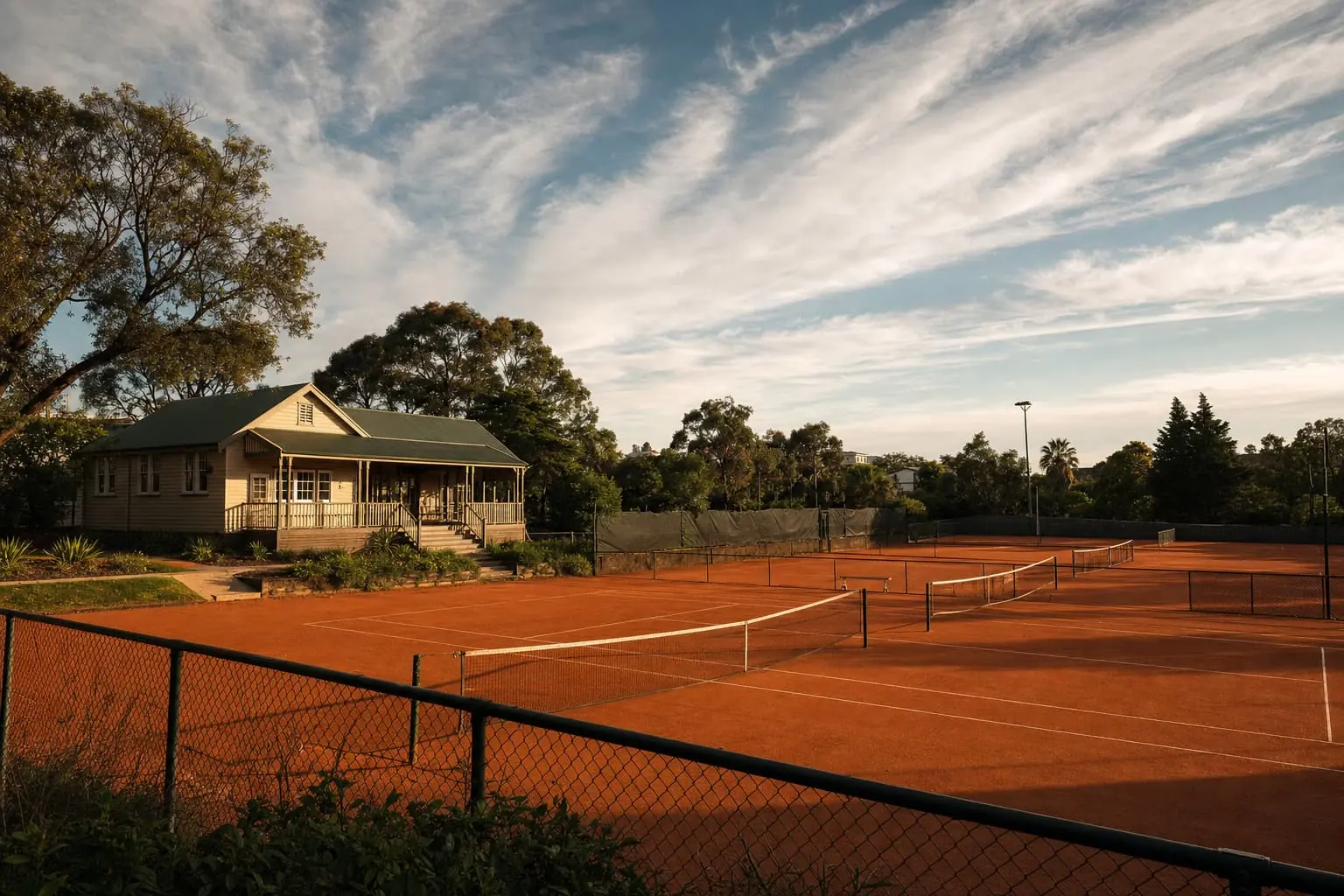
Surface matters in Melbourne. The same city gives you hard courts, synthetic grass and clay, and they play differently. Agree the surface when you accept a challenge.
When you can play
Melbourne plays year-round, with the caveat everyone who lives there will make about the weather changing inside an afternoon.
October to April
is the outdoor season and it is long and good. The Bureau of Meteorology's long-term mean maximum at its Melbourne Regional Office station is 25.9°C in January and February.
May to September
is cool: the mean maximum drops to 13.5°C in July. Monthly rainfall totals barely change through the year, but rain comes on more days, about ten a month from May to October against five or six from January to March. Play continues on floodlit synthetic grass, and Melbourne Park has eight indoor courts for the worst evenings.
The practical planning note is that a Melbourne match is more likely to be interrupted than cancelled. Build in a rain rule that lets a match resume or reschedule without consuming the play window.
Recommended season length: twelve weeks, starting in October. Melbourne can carry a longer season than most cities here because the court supply holds up.
How a ladder works here
The shared mechanics are the same in every city. What changes here is the format, and it changes because of the court slot.
Courts are hired by the hour, and clubs will often let a booking run long if the next slot is free.
- A longer booking. If your ladder accepts it, best of three with a ten-point match tiebreak replaces the full deciding set. Check the ladder’s actual default before agreeing the format.
- A shorter booking. Consider an eight-game pro set or short sets to four if the ladder accepts them. No point-based format guarantees a finish before the booking ends; agree how to handle an unfinished match.
The mechanics
These are the defaults. An organizer can change most of them when the ladder is set up.
| Rule | Default |
|---|---|
| Challenge range | Five rungs up. Rung 6 may challenge rung 1 |
| Response window | 5 days |
| Play window | 30 days from acceptance |
| First challenge | One unrestricted challenge inside your own level band. Always on |
| Rematch cooldown | 14 days. Playing someone else does not shorten it |
| Absence | Up to 21 days. You keep your rung and cannot be challenged |
| Inactivity | Points decay every 30 days without a played match. Your rung is released at 180 days and you are withdrawn at 365 |
The thirty-day play window is generous here. The tighter limit is booking notice: some venues take non-member bookings only a day ahead, so agree the day first and book the moment the venue allows.
Full ruleset at /rules. Scoring and verification at /scoring.
Levels and where you start
Australia runs on UTR, linked to a Tennis ID through a competitive player profile. Melbourne club players will also describe themselves by team grade, which is a usable seeding signal.
Deuce accepts whatever you have: NTRP, UTR, WTN, LTA rating, ITN, a national federation ranking, or a club level. All of them are optional. If you have none, describe your game and the system places you.
Two rules to know before you sign up:
- Low confidence places you high, not low. When we are unsure, you start at the top of the plausible range, never the middle and never the bottom. An underplaced player gets easy matches, which is the fastest way to ruin a ladder for everyone else.
- Your first challenge fixes it. One unrestricted challenge anywhere inside your band, played once, corrects a bad placement in a single match.
How the rating systems compare across countries is at the conversion table. What each NTRP level looks like in a match is on the NTRP rating chart.
How competitive tennis is organized in Melbourne
Organized adult tennis in Melbourne is team-shaped.
Tennis Victoria Pennant
is the state body's inter-club league. A participating club describes it as the largest inter-club team tennis league in Australia, played across metropolitan Melbourne on Saturday afternoons through the winter. Players are graded into club teams and the fixture decides who they meet.
Regional associations
run the weekly club fixtures. Eastern Region Tennis has nearly 80 affiliated clubs across the eastern suburbs and more than 4,000 players in its competitions. Senior matches start at 1:15pm on Saturday and Sunday afternoons, in a summer season from October to March and a winter season from April to September.
Club social play
fills the midweek.
What is missing
is anything for the player who wants competitive singles without committing to a team and a Saturday. That player currently has coaching, social hitting, or nothing.
Questions
Is there a tennis ladder in Melbourne?
Yes. Deuce runs the Melbourne singles ladder, and it is free to join. You challenge players up to five rungs above you and arrange the court between you. The main organized alternative in Melbourne is inter-club team tennis, such as Tennis Victoria Pennant and the regional association fixtures.
What does court hire cost in Melbourne?
At Tennis World Melbourne Park an outdoor hard court costs A$35 an hour off-peak and A$46 at peak, and an indoor court A$53 or A$64. Victorian Tennis Academy centers charge A$28 on weekdays before 4pm, A$38 on weekday evenings and A$34 at weekends. Flagstaff Gardens charges A$24.20 off-peak.
How do I book a tennis court in Melbourne?
Most venues book online. Tennis Australia's Book a Court system lets you find a nearby club and book without a membership. Notice varies: Tennis World takes casual bookings only within 24 hours of play, and Active Melbourne opens its Flagstaff Gardens courts five days ahead.
Can I play tennis in Melbourne in winter?
Yes. The Bureau of Meteorology's long-term mean maximum at its Melbourne station is 13.5°C in July. Winter brings rain on more days, about ten a month from May to October, so floodlit synthetic grass and the eight indoor courts at Melbourne Park carry a winter ladder.
Does court surface matter in Melbourne?
Yes. Fawkner Park, Powlett Reserve and Caulfield Park are synthetic grass. Royal Park Tennis Club has 14 en-tout-cas clay courts. Melbourne Park has hard courts plus four European clay courts. They play differently, so agree the surface when you accept a challenge.
How is a ladder different from pennant?
Pennant is a team competition. You are graded into a club team, and the fixture tells you who you play on Saturday afternoon. A ladder gives you a rung instead. You choose who to challenge, and the two of you agree the date and the court.
What does it cost to join the Melbourne ladder?
Nothing. The Melbourne singles ladder on Deuce is free to join. You pay only for the court, directly to the venue: Tennis World, the Victorian Tennis Academy, Active Melbourne or a club. Who pays for the court is up to the two players.
How do I start a ladder in Melbourne?
Apply through the start-a-ladder form below. It takes about five minutes, and you need ten players you can name. A club, a company team or a regular hitting group all work. Deuce reviews the application and contacts you only if something needs clarifying.
Start a ladder in Melbourne
For a club pro, a volunteer captain, a company team, or one person whose group chat has outgrown itself.
The application is ten questions and takes about five minutes. We review it and get in touch only if something needs clarifying. Once it is approved, the ladder is live and players can join and challenge straight away.
There is no self-serve wizard: every application is reviewed before the ladder opens.
You need ten players you can name. Twelve or more is where a ladder becomes self-sustaining, because that is the point at which the same two people stop playing each other every week. Under ten, apply anyway: we will tell you so rather than launch something thin.
If you already run a ladder in a spreadsheet, there is no import: invite your players once the ladder is approved, and the unrestricted first challenge sorts the order in a round.
Sources and last verified
- Tennis World, Melbourne court hire and facilities
- Victorian Tennis Academy, Fawkner Park, Powlett Reserve and Caulfield Park
- Active Melbourne, Flagstaff Gardens Tennis Courts and prices
- City of Melbourne, Royal Park Tennis Club listing
- Tennis Australia, Book a Court and Elwood Park Tennis Club booking
- Eastern Region Tennis, home page
- West Brunswick Tennis Club, Tennis Victoria Pennant
- Bureau of Meteorology, climate statistics for Melbourne Regional Office
Last verified: September 2026.