
Cities
Tennis ladders in Manila
The Manila singles ladder on Deuce is open, and it's free to join. It covers all of Metro Manila, not just the City of Manila. You pick who you play, and the two of you agree on a court. Quezon City rents its Amoranto Sports Complex court to residents for 100 pesos an hour by day. Members' clubs hold the most courts. PAGASA, the national weather service, declared the 2026 rainy season over for western Luzon on October 5.
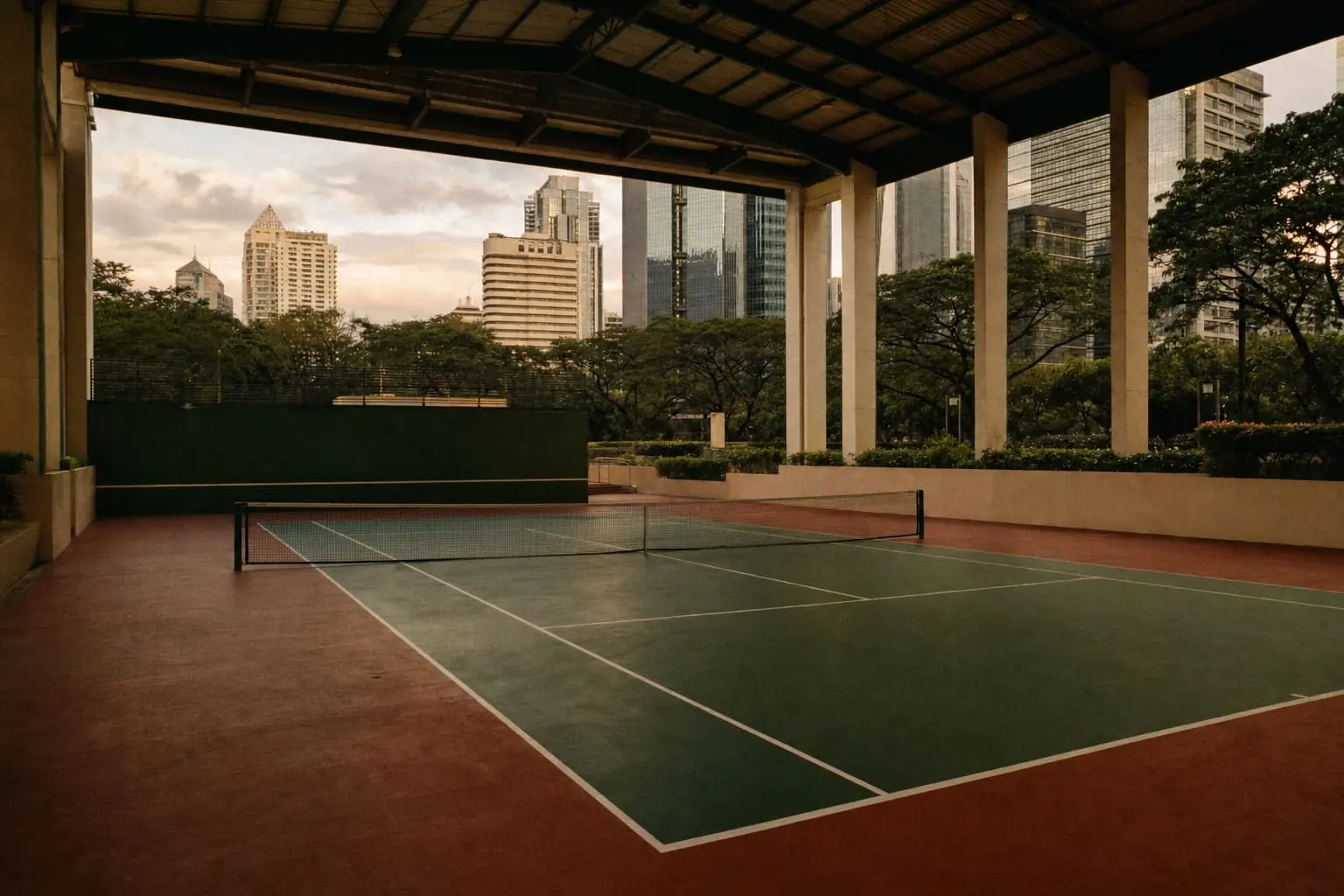
Manila at a glance
| Ladders on Deuce | 1 |
| Active players (last 30 days) | 0 |
| Matches played (last 30 days) | 0 |
Ten players is enough to start a ladder. Below that we would rather tell you so than launch something that dies in three weeks.
Where you would play
Of the venues in the table below, only one posts an hourly rate for people outside a club or hotel, and that's Quezon City's court, for city residents. UP Diliman has four new courts on campus. The big court counts belong to members' clubs in Makati and Pasig, and hotels in Makati, Ortigas and BGC keep courts for guests and health club members.
| Venue | Area | Courts | Surface | Covered or lit | Who can book | Booking | Hourly rate |
|---|---|---|---|---|---|---|---|
| Amoranto Sports Complex | Don A. Roces Ave, Quezon City | Not stated | Not listed | Open air; night rate listed | QC residents, firms, agencies | Letter, email or walk-in | 100 pesos day, 150 pesos night |
| UP Tennis Court and Clubhouse | Ylanan St, UP Diliman, Quezon City | 4 | Acrylic | Night lights | Built for UP athletes and community | UP College of Human Kinetics | Not published |
| Manila Polo Club | Forbes Park, Makati | 15 | Shell and Tru-Flex hard | 10 covered | Members | Sports and Athletics Office | Not published |
| Makati Sports Club | Salcedo Village, Makati | Not stated | Flexipave indoors | Indoor and outdoor courts | Members | Club sports office | Not published |
| Valle Verde Country Club | Capt. Henry Javier St, Pasig | 13 | Not listed | 6 indoor | Members; guest fee 80 pesos an hour | Club | 115 to 180 pesos |
| Kerry Sports Manila | Shangri-La The Fort, BGC, Taguig | 2 | Not listed | Covered | Hotel club; membership offered | Not stated | Not published |
| Makati Shangri-La | Ayala Ave at Makati Ave, Makati | Not stated | Not listed | Not stated | Hotel health club; membership offered | Not stated | Not published |
| Edsa Shangri-La | Ortigas Centre, Mandaluyong | 2 | Not listed | Outdoor | Hotel health club | Not stated | Not published |
| Ascott Makati | Glorietta 4, Ayala Centre, Makati | Not stated | Not listed | Not stated | Residence guests | Not stated | Not published |
"Not stated" means the operator's page doesn't say. "Not published" means it gives no court rate online. We checked every row against the operator's own page on October 7, 2026.
No membership? Then look at Quezon City's court if you live there, ask UP's College of Human Kinetics about its courts, or play at a member's club as their guest where the club allows it, as Valle Verde does for 80 pesos an hour.
Public courts: Quezon City and UP Diliman
Quezon City runs the Amoranto Sports Complex on Don A. Roces Avenue. Its tennis court rents for 100 pesos an hour by day. The city's charter also lists a night rate of 150 pesos, though the posted hours are 8 a.m. to 5 p.m. daily, except on days someone has booked the court for exclusive use. The charter names Quezon City residents, private firms and other government agencies as the people who can rent it. You reserve with a letter, an email to the complex or in person, and pay there.
The University of the Philippines opened four acrylic courts with a clubhouse at UP Diliman in February 2023. The courts have night lights, and the College of Human Kinetics manages them. UP built them for its athletes and students and for recreational play by the UP community. It publishes no rate, so ask the college before you plan a match there.
Members' clubs
Manila Polo Club, on McKinley Road in Forbes Park, has 15 courts: ten covered shell courts in two pavilions and five outdoor hard courts. They're open from 6 a.m. to 10 p.m. every day. It is a members' club, so this is a home for a members' ladder, not a public one.
Valle Verde Country Club in Pasig has 13 courts, six of them indoors. Court fees run from 115 pesos an hour on the outdoor courts to 180 pesos on the tournament courts, and a guest pays a guest fee of 80 pesos an hour. Makati Sports Club in Salcedo Village has an indoor flexipave court and an outdoor court, open until 10 p.m. Monday to Saturday and 8 p.m. on Sundays and holidays.
Hotels and residences
The hotel courts sit in the business districts. Makati Shangri-La lists tennis courts in its health club, open 6 a.m. to 10 p.m. Edsa Shangri-La in Ortigas has two outdoor courts with the same hours. In BGC, Kerry Sports Manila at Shangri-La The Fort has two covered courts, open from 5 a.m. to midnight. All three take members. Ascott Makati, the serviced residence at Glorietta 4, lists tennis courts among its facilities for guests.
None of these pages publishes a rate for a non-guest. Ask the hotel before you offer its court for a ladder match.
Villages and condominiums
Some villages run their own courts. Alabang Hills Village in Muntinlupa is one: its association's March 2023 bulletin set separate rules for members, residents and non-resident guests on the village court. If your building or village has a court, check its house rules on guests before you host a ladder match there.
The tournament courts at Rizal Memorial
Rizal Memorial Tennis Center in the City of Manila is the tournament venue. Its hard courts hosted the first Philippine Women's Open, a WTA 125 event, from January 26 to 31, 2026, with 32 players in the singles draw and 14 doubles teams.
When you can play
Tennis here runs all year, on terms the rain sets. PAGASA splits the year into a rainy season, June to November, and a dry season, December to May. It calls March to May the hot dry months and the most uncomfortable ones, when heat and humidity both peak. The numbers below are PAGASA's 1991 to 2020 normals for its Port Area station in the City of Manila.
| Months | Normal high | Normal low | Rain | Rainy days a month |
|---|---|---|---|---|
| December to February | 29.9 to 30.7°C (86 to 87°F) | 23.9 to 24.6°C (75 to 76°F) | 19 to 99 mm | 3 to 8 |
| March to May | 32.1 to 33.8°C (90 to 93°F) | 25.3 to 27.0°C (78 to 81°F) | 22 to 159 mm | 3 to 9 |
| June to September | 31.0 to 32.8°C (88 to 91°F) | 25.7 to 26.5°C (78 to 80°F) | 253 to 476 mm | 14 to 19 |
| October and November | 31.3 to 31.4°C (88 to 89°F) | 25.3 to 25.7°C (78°F) | 120 to 221 mm | 10 to 14 |
August is the wettest month at Port Area, with 476 mm of rain on about 19 days, and June to September each bring about ten thunderstorm days. Rain isn't even across the metro. PAGASA's Science Garden station in Quezon City records about 2,786 mm a year against 2,243 mm at Port Area.
In 2026, PAGASA declared the rainy season open over western Luzon on June 4 and declared it over there on October 5. PAGASA also says typhoons bring a large share of the country's rain. If one is on the way, don't play; move the match inside the play window instead.
How a ladder works here
A Manila ladder runs on the same rules as any other. What changes here is getting two players onto one court. With so few courts open by the hour, most matches will be played where one of you already plays: a club, a hotel membership, a village or a building. Pick one you can both reach. A match between Alabang and Quezon City means one of you crosses the whole metro.
The Manila ladder records best of three tiebreak sets, the platform default. The rules say it plainly: a one-hour slot is not best of three. Book two hours where you can. From March to May, play early or after dark on a lit court. From June to September, look for a covered court: at Valle Verde an indoor court costs 130 pesos an hour, against 115 outdoors. The challenger books the court unless you agree otherwise, so when you accept, agree on the court and on who pays for it.
The mechanics
If you've played on a ladder before, this table is all you need. An organizer can change the challenge range, the two windows and the rematch cooldown. The first challenge, the absence rule and the inactivity schedule stay fixed.
| Rule | Default |
|---|---|
| Challenge range | Five rungs up. Rung 6 may challenge rung 1 |
| Response window | 5 days |
| Play window | 30 days from acceptance |
| First challenge | One unrestricted challenge inside your own level band. Always on |
| Rematch cooldown | 14 days. Playing someone else does not shorten it |
| Absence | Up to 21 days. You keep your rung and cannot be challenged |
| Inactivity | Points decay every 30 days without a played match. Your rung is released at 180 days and you are withdrawn at 365 |
The 30-day play window gives a rained-out match room to move. If a typhoon or a trip takes you out for a while, mark yourself absent: you keep your rung for up to 21 days, and nobody can challenge you. The whole ruleset is on the rules page, and scoring covers how a result gets confirmed, and the glossary explains rung, level band and the rest.
Levels and where you start
Manila players bring whatever rating they picked up back home or at their club, and some bring none. Deuce takes NTRP, UTR, WTN, an LTA rating, ITN, a national federation ranking or a club level. None of them is required: describe your game in plain words and you'll be placed from that.
- Unsure means higher. Between a 3.5 and a 4.0, you go in as a 4.0. Someone placed too low wins matches they shouldn't, and every rung below feels it.
- One match corrects it. Your first challenge may go to anyone in your level band, so a bad placement lasts one result.
To line up NTRP, UTR and WTN, use the rating conversion table. What each NTRP level looks like in a match is on the NTRP rating chart.
How competitive tennis is organized in Metro Manila
Organized tennis around Manila runs through a national association, one pro tournament, the clubs' coaching programs and a few social groups on an app. What follows comes from each one's own page, or a government page, as of October 7, 2026.
The national association. The Philippine Tennis Association (PHILTA) signed an agreement with the Bases Conversion and Development Authority in September 2025 to build a Philippine Tennis Center on about 10 hectares in New Clark City, Tarlac.
The pro game came to town in January 2026, when the Philippine Women's Open, a WTA 125 tournament, made its debut at Rizal Memorial.
Club programs. The members' clubs coach. Manila Polo Club lists 59 accredited professionals and trainers, and Valle Verde runs beginner, intermediate and advanced programs with three named coaches. Both are for members.
Outside the clubs, some groups organize on Reclub, a sports community app. Makati Tennis Buddies runs drills and friendly matches for beginners, and The Tennis Syndicate, which plays in Metro Manila and Metro Davao, posts regular sessions for beginner and intermediate players.
None of these describes a singles ladder across the metro on its own pages. A Deuce ladder is one. You challenge when you're ready, the other player has 5 days to answer, and an accepted match has 30 days to get played. Those deadlines stop a challenge from stalling, but the court is still yours to find.
A ladder won't suit every player. Coached drills and a friendly hit are what the club programs and the Reclub groups are for. Doubles on a set night needs a group that plays one, and a Deuce city ladder is singles.
Questions
Is there a tennis ladder in Manila?
Yes. Deuce runs the Manila singles ladder, which covers all of Metro Manila, is open-ended and is free to join. You choose who to challenge within five rungs, and you and your opponent agree on the court and the time. For coaching or a friendly hit, the clubs and the Reclub groups above are the better place to look.
How much does a tennis court cost in Manila?
It depends on who runs it. Quezon City's Amoranto court costs residents 100 pesos an hour by day and 150 pesos at night. Valle Verde Country Club charges 115 to 180 pesos an hour, with an 80-peso guest fee. The hotels, Manila Polo Club and Makati Sports Club post no court rate online. Rates as of October 2026.
Are there public tennis courts in Metro Manila?
Quezon City rents the Amoranto Sports Complex court to residents, private firms and government agencies, from 8 a.m. to 5 p.m. UP Diliman has four lit courts built for UP athletes, students and the UP community. Most other courts in the metro belong to clubs, hotels, villages and buildings.
How do I book a tennis court in Manila?
At Amoranto, send a request letter or an email to the complex, or ask in person, then pay there. At UP Diliman, contact the College of Human Kinetics. Club courts go through the club's sports office, and hotel courts through the health club. The challenger books unless you agree otherwise.
Where are the covered or indoor tennis courts in Metro Manila?
Manila Polo Club has ten covered shell courts and Valle Verde Country Club has six indoor courts, both for members. Makati Sports Club has an indoor court for members. In BGC, Kerry Sports Manila has two covered courts. That's where a match goes when the June to September rain sets in.
Where can I play tennis in Makati or BGC?
In Makati, Manila Polo Club and Makati Sports Club have courts for members, Makati Shangri-La lists courts in its health club, and Ascott Makati has courts for guests. In BGC, Kerry Sports Manila has two covered courts and sells memberships. None publishes a public hourly rate.
When is the rainy season in Manila, and what about typhoons?
PAGASA puts the rainy season from June to November. In 2026 it declared the season open on June 4 and over on October 5 for western Luzon. August is the wettest month at Port Area. Typhoons bring much of the rain, so move a match inside the 30-day play window.
Where can I take lessons or join a tennis club in Manila?
Manila Polo Club lists 59 accredited professionals and trainers, and Valle Verde Country Club runs beginner, intermediate and advanced programs with three named coaches. Both are members' clubs. For a social start outside a club, Makati Tennis Buddies on Reclub runs drills for beginners.
How is a ladder different from a league?
A league hands you a schedule and opponents. A ladder gives you a rung, and you choose whom to challenge within range and when to play, inside a response window and a play window. Confirmed results earn Deuce Points, which order the standings. How it works explains it.
What does it cost to join?
Nothing. Deuce Ladder is free for players right now. You pay the court where it charges, as the court answers above explain. Deuce doesn't book or sell court time. Browse open ladders on Discover, or see what players get.
How do I start a ladder in Manila?
Apply as an organizer. You need ten players you can name: a village, a condominium, a club's members, a workplace in Makati or BGC, or a regular hitting group. Deuce reviews every application before the ladder opens. The steps are below and on the organizers page.
Start a ladder in Manila
The city ladder is for singles players from anywhere in the metro. A smaller ladder works for a group that already shares a court: a village with its own court, a condominium, members at Valle Verde or the Polo Club, an office in Ortigas or a Reclub group that wants its friendly matches to count.
Applying takes about five minutes: ten questions and a free-text box. A person at Deuce reviews it and only gets in touch if something needs clarifying. Approval puts the ladder live, and your players can join and send challenges straight away.
You need ten players you can name. Twelve or more works better, since a small group keeps meeting the same opponents. Short of ten? Apply anyway, and we'll tell you if the group is too thin.
If your group keeps a ranking in a spreadsheet or a chat, there's no import. Invite the players once you're approved, and their unrestricted first challenges settle the order.
Sources and last verified
- Amoranto Sports Complex and its tennis court charter, Quezon City Government
- Sports facilities, UP Diliman Office for Initiatives in Culture and the Arts, and UP opens new tennis courts and clubhouse, University of the Philippines
- Tennis and About Us, Manila Polo Club
- Tennis and Contact, Valle Verde Country Club
- Sports and Recreation and Contact Us, Makati (Sports) Club
- Kerry Sports Manila, Shangri-La The Fort
- Health Club, Makati Shangri-La, and Health Club, Edsa Shangri-La
- Ascott Makati, The Ascott
- Tennis court bulletin, March 2023, Alabang Hills Village Association
- Philippine Women's Open 2026, WTA
- BCDA, PHILTA to establish a tennis center in New Clark City, Bases Conversion and Development Authority
- Makati Tennis Buddies and The Tennis Syndicate, Reclub
- Climate of the Philippines, Onset of the rainy season, June 4, 2026, Termination of the southwest monsoon, October 5, 2026, and the 1991 to 2020 climatological normals for Port Area and Science Garden, PAGASA
Last verified: October 2026.