Skip to content
Deuce Ladder

The format

How scoring and rung movement work

Scoring rules edition 1.1. Effective August 13, 2026. Changes to the five-step tiebreaker or the falsification penalty carry a new edition number and a date at the top of this page.

Two things happen when a ladder match ends: the standings change, and the result gets verified. Most platforms treat the second as paperwork. It is the other way around. Ranking math is solved. The unsolved part is getting two people to agree in writing about what happened on a public court with no umpire.

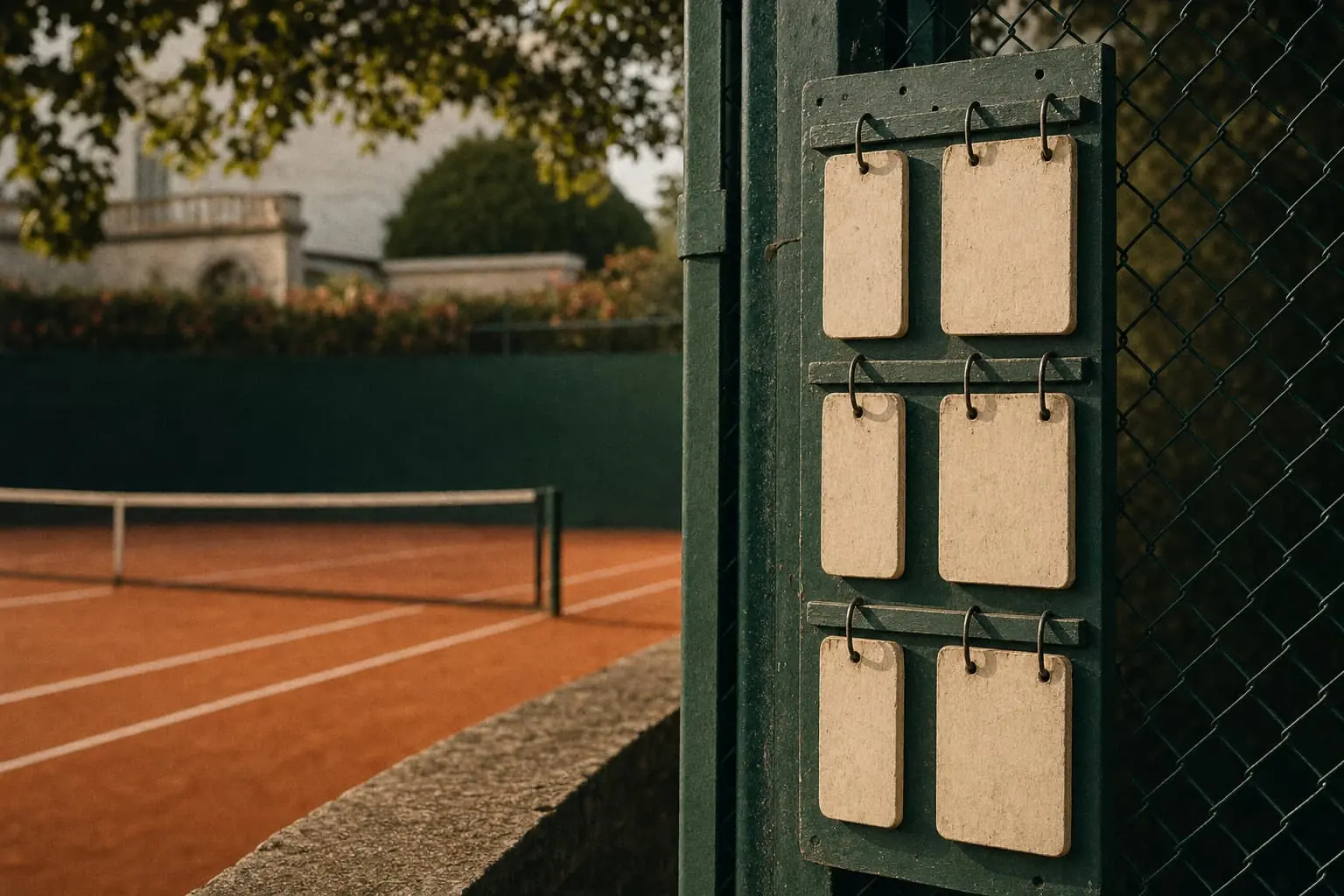
A wooden courtside scoreboard with blank number plates hanging on a green fence beside a clay court.

The two movement models

A ladder can be run two ways. Clubs use both, and neither is wrong.

Positional swap

Beat the player above you and you take their rung. They take yours. Nobody else moves.

Points

Every result awards points and the standings sort by total. Rungs are an output of the arithmetic rather than a thing you take from a person.

Positional swap Points
What a win gets you The loser's exact rung A number added to your total
Who else moves Nobody Anyone whose total you passed
Reward for playing a lot Indirect: more chances to climb Direct: volume accumulates
Readability High. Anyone understands a swap Lower. Requires reading a table
Failure mode A strong player who plays twice a season keeps a high rung A weak player who plays constantly outranks a strong one who does not

The organizer picks one at launch and it is published before anyone joins. In a doubles ladder the pair is the ranked entity, so everything here belongs to the pair: one rung, one point total, one tiebreak record. Rules 2.7 and 4.6 of the rules set that out.

Why Deuce defaults to the swap

It is legible

A new player gets "beat him and you take his spot" the first time they hear it. A points table has to be read before it means anything, and a scoring system nobody can recite is one nobody trusts.

It makes a challenge feel like something

Under a swap you are playing for one rung held by one person on the other side of the net. Under points you are both playing for an increment. The difference shows up in completion rates long before it shows up in anybody's ranking.

It cannot be farmed by volume

In a points ladder the fastest route up is a stack of easy matches. A swap gives you nothing for beating someone below you, which is why rule 5.2 does not let you challenge downward.

The honest cost is that a swap rewards holding still: sit on rung 2, defend twice a season, and the model on its own will never move you. Inactivity decay closes that gap, which is why decay cannot be switched off. The movement model and decay were designed as one thing.

What points are for

Even in a swap ladder, Deuce keeps a point total. It does not set your rung. It breaks ties in the final standings, seeds the playoff between adjacent rungs, and pays for the behavior a ladder runs on, because somebody has to send the challenge.

Event Points Notes
Win a played match {{PTS_WIN}} The core award
Lose a played match {{PTS_LOSS}} Not zero. Playing is worth something
Send a challenge that gets played {{PTS_CHALLENGE_SENT}} Awarded on play, never on send. Rule 12.7
Accept a challenge you received {{PTS_CHALLENGE_ACCEPTED}} Awarded on play. Accepting fast is what is being paid for
Win by walkover {{PTS_WALKOVER_WIN}} Less than a played win
Give a walkover {{PTS_WALKOVER_GIVEN}} Negative
Forfeit after accepting {{PTS_FORFEIT}} Negative, larger than a walkover given
Voided match, rule 7.4.3 0 Neither player gains or loses
Win a set as the losing player {{PTS_SET_WON}} Optional, off by default

Platform defaults, published here rather than buried in a settings screen

Win 10, loss 2, challenge sent 3, challenge accepted 3, walkover win 5, walkover given −3, forfeit −5, set won as loser 0. Every one is a per-ladder setting, and your ladder's values print on your ladder's copy of this page.

Configurable, but not to any number an organizer likes

A win must be worth more than a loss, a walkover win less than a played win, and giving a walkover or forfeiting never more than zero. Validated on save, not discovered in week seven.

Points reset each season

Rungs may carry over under rule 16.9; points never do. A total built across twelve weeks would outweigh a whole new season.

Challenge points are paid on play, never on send

Pay on send and you are paying people to fire off challenges they never intend to play. Homemade point systems make this mistake more than any other.

The tiebreaker order for final standings

Two players finish level. Most club ladders leave that to whoever is running the thing, decided on the night, which is how a season ends in an argument. Deuce publishes the order instead, applied automatically, stopping at the first step that separates them.

  1. Matches played, higher first. The whole point of a ladder is played tennis.
  2. Head-to-head between the tied players. They played and one of them won. If they never met or split evenly, this separates nobody and the comparison moves on.
  3. Sets won minus sets lost.
  4. Games won minus games lost.
  5. Most recent played match, earlier first.

Walkovers received do not enter step 1; they are not played matches. Voided matches under rule 7.4.3 enter no step.

Two players can still be level after step 5. Rare is not never, and an unwritten rule is the one that causes trouble: they share the rung in the published standings, and the playoff place goes to whoever has given fewer walkovers (a column already visible under rule 4.4), and then to whoever played their first match of the season earlier. Neither step is a judgment call.

No rating enters that chain, and none ever will. A rung should never depend on a number a player cannot recompute from the results in front of them.

What a walkover is worth

What happened Rung effect Points Counts toward the playoff minimum
You win a played match You take their rung {{PTS_WIN}} (10) Yes
Your opponent never responded You take their rung {{PTS_WALKOVER_WIN}} (5) No. Rule 16.5
Your opponent accepted, then never played You take their rung {{PTS_WALKOVER_WIN}} (5) No
You accepted, then did not play They take your rung {{PTS_FORFEIT}} (−5) No
You never responded to a challenge They take your rung {{PTS_WALKOVER_GIVEN}} (−3) No
Neither could find a slot, and both offered Nothing moves 0 No

A declared absence is not in that table, because an absence is not a result: rule 5.7 blocks a challenge to an absent player at the point of sending.

A walkover moves the rung but not the credibility. You take the position, because the alternative is a player who never responds keeping a rung forever. You do not take full points and it does not count toward playoff qualification, because no tennis was played.

So you cannot reach a playoff on other people's silence. And in the other direction, give {{MAX_WALKOVERS}} walkovers in a season and the platform sets you inactive until the organizer lifts it. Section 11 lets you declare an absence at no cost instead, which is why almost nobody should ever reach that rule.

A worked example

One band, eight players, one round. Positional swap with points kept as the tiebreak. Player A through Player H are labels, not people.

Everything below is computed by the same code that runs a live ladder: a fixture that executes against the production engine on every build, so if a rule changes and this page does not, the build fails.

Before the round

Rung Player Played W L Points
1 Player A 4 4 0 46
2 Player C 3 2 1 31
3 Player B 5 3 2 44
4 Player D 4 2 2 33
5 Player E 2 1 1 18
6 Player G 1 0 1 6
7 Player F 5 2 3 35
8 Player H 0 0 0 0

What happened

  1. Player E (rung 5) challenged Player B (rung 3) and won 6-4 3-6 10-7.
  2. Player G (rung 6) challenged Player D (rung 4) and lost 2-6 4-6.
  3. Player H (rung 8) used the unrestricted first challenge in rule 5.4 to reach Player C on rung 2 and won 8-5 in a pro set. Six rungs up: rule 5.1 alone would have capped Player H at rung 3.
  4. Player F (rung 7) challenged Player A (rung 1). Blocked at sending: six rungs up, outside range.
  5. Player A received no challenge and played nothing. Twenty-two days since their last played match, one day past the decay trigger in rule 12.1.

After the round

Rung Player Played W L Points What moved them
1 Player H 1 1 0 13 Beat Player C and took rung 2, then inherited rung 1 when Player A decayed past them
2 Player A 4 4 0 46 Played nothing. Decayed one rung under rule 12.2
3 Player E 3 2 1 31 Beat Player B and took rung 3
4 Player D 5 3 2 46 Defended against Player G and held
5 Player B 6 3 3 49 Lost to Player E and dropped to rung 5
6 Player G 2 0 2 11 Lost to Player D and held rung 6
7 Player F 5 2 3 35 Nothing. The blocked challenge cost nothing
8 Player C 4 2 2 36 Lost to Player H and took Player H's rung

The swap is exact

Player H went from rung 8 to rung 2 in one match and Player C went from 2 to 8. Nobody in between moved.

Points and rungs disagree, and that is correct

Player B sits on rung 5 with the highest total in the band because they have played six matches. Player H sits on rung 1 with 13 points. The rung answers who beat whom; the total answers who has been carrying this ladder. And if a brand-new player on rung 1 looks wrong, look at what it costs them: challengeable by everyone within five rungs, one played match against a playoff minimum of four.

Decay does the work no result could

Player A is 4-0 and dropped a rung anyway, without anyone reporting or messaging them. Twenty-two days of not playing did it, and one match stops it.

Player G lost and still gained

No wins all season, and one of the three matches played this round happened because Player G sent the challenge.

How a score gets confirmed

1

The winner submits

within {{SCORE_SUBMIT_WINDOW}} hours, set by set, from a picker that only offers legal scorelines.

2

The loser gets the exact scoreline.

One tap to confirm, one to dispute. Matching entries from both players confirm on the spot; entries that do not match are a dispute from the start.

3

On confirm the standings move right away.

Not on a nightly job.

4

On silence it auto-confirms after {{SCORE_CONFIRM_WINDOW}} days.

This is the load-bearing step. Without it, any player who dislikes a result can freeze the other player's rung by doing nothing. Silence is not a veto.

Auto-confirm never happens quietly: you are notified on submission, at the halfway point, and 24 hours before it confirms. All three are logged, which is what makes the confirmation defensible later.

If the winner has not entered the score, the loser can, and the winner then holds the confirmation clock. Either player can also dispute, which pauses the clock; both state their version once in writing and the organizer resolves it under section 18. Nothing is decided in a private message. If the organizer is one of the two players, they do not rule on it. It goes to Deuce under rule 17.7.

Score verification is the weakest point in this category.

Of five tennis ladder and flex league platforms surveyed, one required both parties to verify a result, and one published a penalty for falsifying one.

Source: Deuce Ladder competitive research, survey of five ladder and flex league platforms, July 2026.

Deuce does both. The auto-confirm timer is there so that doing both does not make the system easy to stall.

Which scorelines are accepted

Deuce turns down anything else at the moment of entry, not in a review queue three days later. An impossible score cannot be saved, so it cannot sit in the standings all season.

Accepted, matching the six formats in rule 8.5:

  • Games in a set: 6-0, 6-1, 6-2, 6-3, 6-4, 7-5, 7-6, and the same reversed.
  • A 7-6 set requires a tiebreak reaching at least seven points, won by two. 7-5 is valid, 7-6 is not, 9-7 is.
  • Best of three, with a match tiebreak to 10 permitted in place of a third set: 10 points and a two-point margin, so 10-8 is valid and 10-9 is not. A long tiebreak records at its real score. The same third-set swap is accepted in a best of three tiebreak sets match when both players agreed to it on court under rule 8.4.2.
  • One tiebreak set.
  • Eight-game pro set: first to eight by two, or 9-8 with a tiebreak at 8-8.
  • Short sets to four: 4-0, 4-1, 4-2, and 4-3 where a tiebreak was played at 3-3.
  • FAST4: short sets as above with the 3-3 tiebreak to five points. 4-1 4-3 passes; a FAST4 set of 5-3 does not.
  • Retirements: the completed part of the score plus a retirement marker. If no set was completed there is nothing to record and the match is rescheduled under rule 7.6.

No-ad is not on this list. It is a scoring option inside a format under rule 8.5.1, and produces the same set scores as an advantage match.

Rejected: 8-6 against a best-of-three format, or 6-4 6-2 against a pro set. Format and scoreline must agree. A set of 6-5. A match tiebreak entered as the first or second set. A third set where the same player already won the first two. And a walkover entered as 6-0 6-0, which is why the whitelist exists at all: homemade ladder spreadsheets fill up with them, and by the end of a season nobody can tell which matches were played.

What happens if someone fakes a score

A first confirmed case of falsifying a score voids the result and returns both players to their pre-match rungs. It also places a permanent marker on the match record, visible to that ladder's players. A second confirmed case removes the player from the ladder for the remainder of the season and forfeits playoff eligibility.

Source: Deuce Ladder rules, rule 17.5, edition 1.1 effective August 13, 2026.

"Confirmed" means the organizer resolved a dispute against the submitting player, or both players later agreed the record was wrong. It does not mean accused.

Nobody planning outright fraud is talked out of it by a paragraph. The person weighing a small adjustment to a scoreline nobody would check is exactly who a published penalty reaches.

Why two identical scores can carry different weight

Every confirmed match carries a provenance tier, written at the same moment as the result and shown on the match record, yours and everybody else's.

Tier How the result was established How it reads on the match record
Verified Entered or countersigned by the organizer, or logged at a club with on-site confirmation Highest
Confirmed Submitted by one player, actively confirmed by the other High
Auto-confirmed Submitted by one player, unanswered, confirmed by the timer Reduced
Contested Disputed and resolved by the organizer Reduced, and marked
Unverified Played outside the challenge system (rule 8.8), or imported from a spreadsheet Lowest

If your ladder moved to Deuce from a spreadsheet, that history sits in the bottom tier and says so. That is not a judgment on how your old ladder was run. Nobody countersigned those scores, so nothing about them can be checked now, and marking them as checked anyway would make every record built on top of them slightly false.

Organizer verification is a per-ladder setting: required on every match, allowed on any, or off, and whichever you pick is published before anyone joins.

Provenance is published on the match record and nowhere else. It does not affect your rung, which is the outcome of your ladder's rules applied identically to everyone. A club that countersigns its matches produces better records than a park ladder where every score is self-posted, and a platform treating those the same is lying to both.

Setting this up for your own ladder

You choose the movement model, the point values, the auto-confirm window, and whether you sign off results yourself. What you cannot change is on the fixed list in section 19 of the rules: both players confirm, only real scorelines are accepted, and the penalty for faking one is the published one. Those three are what a player trusts when they join your ladder without knowing you.

Open the ladder simulator Start a ladder What organizers get Join a ladder Terms used on this page More questions

You pick who you play. We make sure the match actually happens.

Tennis Ladder Scoring System | Deuce Ladder