
Cities
Tennis ladders in New York City
The New York singles ladder is open on Deuce, and anyone can join. Here is where you would play, how the Parks permit works, why the format has to be short, and how the ladder works.
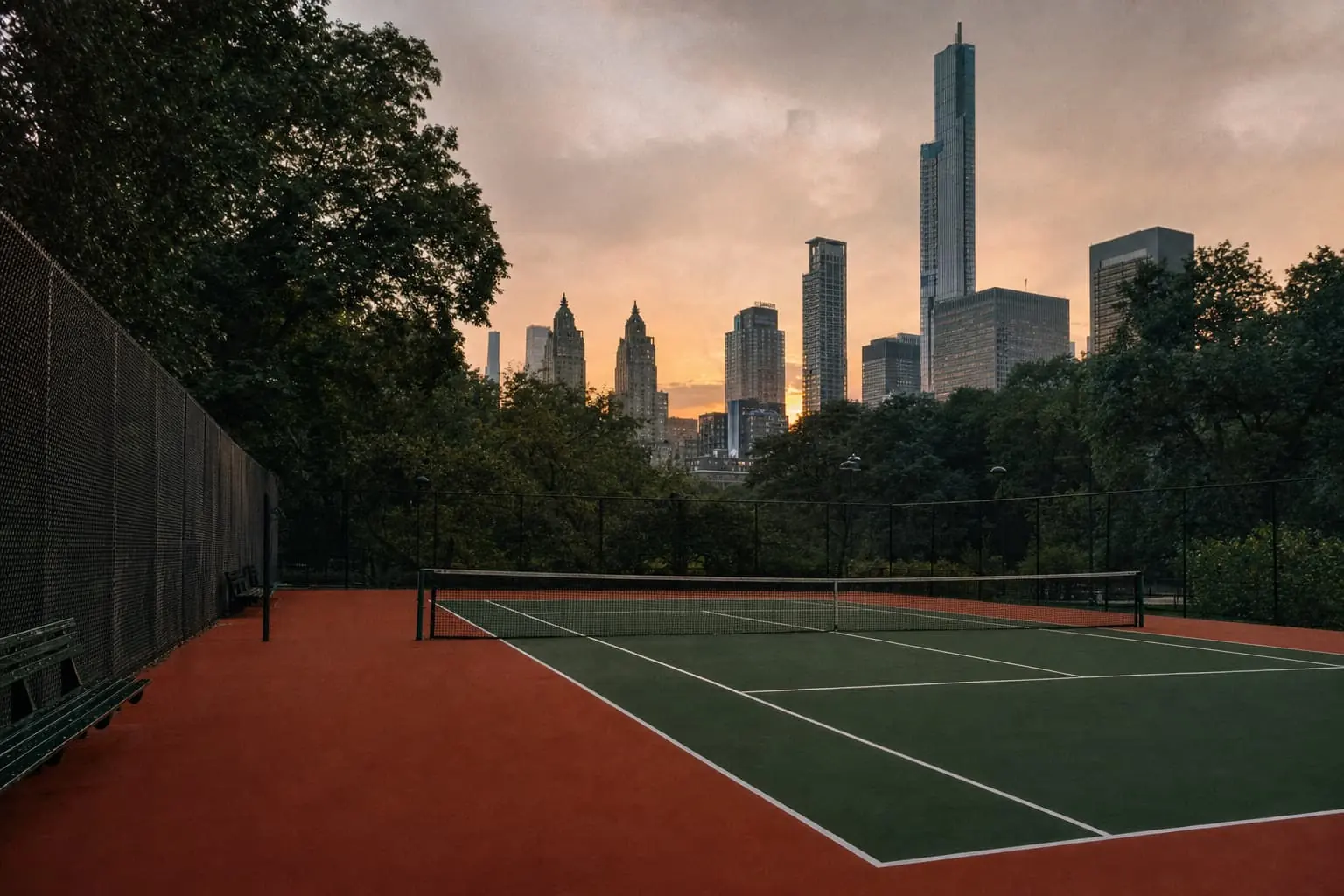
New York City at a glance
| Ladders on Deuce | 1 |
| Active players (last 30 days) | 0 |
| Matches played (last 30 days) | 0 |
Ten players is enough to start a ladder. Below that we would rather tell you so than launch something that dies in three weeks.
Where you would play
New York's public tennis runs on a permit system, and the permit shapes everything about a ladder here.
The permit
You need one to use an outdoor public court, and the season runs from the first Saturday in April to the Sunday before Thanksgiving.
| Permit | Cost |
|---|---|
| Full season, adults 18 to 61 | $100, with 10 percent off if you hold a valid IDNYC |
| Full season, seniors 62 and over | $20 |
| Full season, under 18 | $10 |
| Single play | $15 |
A single-play permit buys one hour of singles. The same $15 permit buys two hours for doubles, which is worth knowing if you are running a doubles ladder here rather than a singles one.
Permits cannot be refunded or transferred, and a full-season permit costs the same whenever in the season you buy it. Online purchases can take up to three weeks to arrive by mail. In person at a borough permit office, you walk out with it.
Getting on a court
Two different systems, and most people only know about one.
- A few popular courts take online reservations at $15 per court per hour, up to seven days ahead, not counting the day you book, until midnight the night before.
- Everywhere else, you turn up with your permit and reserve a court on the spot for same-day use.
For a ladder this is the key operational split. At a reservable court you can schedule a match up to seven days out. At every other court you cannot schedule anything, you agree a time and both show up.
Central Park and Prospect Park also sell advance reservation tickets at $15 per court per hour, redeemed by phone or in person.
Hours
Most courts run from 8:00am to dusk. Central Park opens at 7:00am. Randall's Island runs 7:00am to 7:00pm.
Dusk is not a detail. Most New York public courts have no lights, so the playable evening window shrinks steadily through September, October and November, exactly when a fall season is running. An autumn ladder here should shift toward weekend mornings as the season goes on.
Indoor and private facilities
Indoor clubs, bubbles and commercial courts operate year-round at a large premium. They are the only way tennis happens in New York between Thanksgiving and April.
When you can play
New York has the shortest public season of any city in this set.
April to November
is the public season, fixed by the Parks calendar rather than by weather. Summer is hot and humid, spring and autumn are excellent.
Late November to March
is indoor only, and expensive.
Recommended season length: ten weeks, starting in late April or early September
Do not plan an outdoor season that crosses the Thanksgiving closure.
How a ladder works here
The shared mechanics are the same in every city. What changes here is the format, and it changes because of the court slot.
A single-play permit buys one hour. Build the ladder around that.
- One hour. An eight-game pro set, or short sets to four with a tiebreak at 3-3, or FAST4. All three suit the hour, but a close match can still run past it, so agree before you start what happens if the slot ends first. Pro set rules.
- Best of three is not the default here. Two players holding seasonal permits can play longer if the court is free, but a ladder cannot assume it.
This is the clearest example on the whole site of the principle in /rules: size the format to the
slot you can actually get.
The mechanics
These are the defaults. An organizer can change most of them when the ladder is set up.
| Rule | Default |
|---|---|
| Challenge range | Five rungs up. Rung 6 may challenge rung 1 |
| Response window | 5 days |
| Play window | 30 days from acceptance |
| First challenge | One unrestricted challenge inside your own level band. Always on |
| Rematch cooldown | 14 days. Playing someone else does not shorten it |
| Absence | Up to 21 days. You keep your rung and cannot be challenged |
| Inactivity | Points decay every 30 days without a played match. Your rung is released at 180 days and you are withdrawn at 365 |
The Thanksgiving closure is a hard stop, not a weather delay. A challenge issued in mid-November can run into the closure long before its play window ends. An organizer running a late-autumn season should shorten the play window in the final weeks or end the season before the courts do.
Match the play window to the court type. At a walk-on court there is nothing to book, so 30 days is generous. At a reservable court the booking window is seven days, so the challenger should book first and offer the slot.
Full ruleset at /rules. Scoring and verification at /scoring.
Levels and where you start
The United States runs on NTRP, and most New York players know their number or can estimate it. UTR is common among juniors, college players and the stronger adult competitive population. Both are accepted, along with a club level.
NTRP runs high-is-strong on a 1.5 to 7.0 scale.
Deuce accepts whatever you have: NTRP, UTR, WTN, LTA rating, ITN, a national federation ranking, or a club level. All of them are optional. If you have none, describe your game and the system places you.
Two rules to know before you sign up:
- Low confidence places you high, not low. When we are unsure, you start at the top of the plausible range, never the middle and never the bottom. An underplaced player gets easy matches, which is the fastest way to ruin a ladder for everyone else.
- Your first challenge fixes it. One unrestricted challenge anywhere inside your band, played once, corrects a bad placement in a single match.
How the rating systems compare across countries is at the conversion table. What each NTRP level looks like in a match is on the NTRP rating chart.
How competitive tennis is organized in New York City
New York has a large amount of organized adult tennis and a permit system that funnels all of it through the same courts.
Federation flex leagues
are the main structured product, and they assign your opponents based on availability rather than letting you choose.
Club and facility leagues
run inside private and indoor venues for members.
Informal groups
carry the rest, coordinated on messaging apps around whoever has a permit and a court.
Looking for someone to hit with
rather than a ladder opponent? Finding a tennis partner in New York City covers the clinics, the USTA teams and the hitting partners board, and how to settle permits and courts with someone new.
What is missing
is the choice. Every structured format here hands you an opponent. A ladder does the opposite, and in a city with this much density and this little court time, choosing well matters more than it does anywhere else.
Questions
Is there a tennis ladder in New York?
Clubs and informal groups run them. The main structured public products are leagues that assign opponents. Deuce runs the New York singles ladder. It is open-ended, and anyone can join.
Do I need a permit to play on a public court in New York?
Yes. A full-season permit is $100 for adults 18 to 61, $20 for seniors 62 and over, and $10 for under 18s. A single-play permit is $15 and covers one hour of singles at any court in any borough.
Is a season permit worth it for a ladder?
If you will play seven or more matches, yes. At $15 a time, a single-play permit costs more than a $100 season permit by the seventh match, and most ladder players will pass that inside a season.
When is the public tennis season?
From the first Saturday in April to the Sunday before Thanksgiving. Outside those dates the public courts are closed.
Why is the match format so short?
Because a single-play permit buys one hour of singles. An eight-game pro set, short sets, or FAST4 can fit inside it, though a close match may not. Best of three does not. The same permit buys two hours for doubles, so a doubles ladder can run a longer format.
Can I book a court in advance?
At a few popular courts, yes: online, $15 per court per hour, up to seven days ahead. At every other court you turn up with your permit and reserve on the spot for the same day.
Where do I play in winter?
Indoor clubs and bubbles. They run year-round at a significant premium.
What rating does US tennis use?
NTRP, on a 1.5 to 7.0 scale where higher is stronger. UTR is also common. Deuce accepts either.
What does it cost to join?
Nothing. Deuce Ladder is free for players right now. Permits and indoor court fees are separate.
How do I start one?
Below. You need ten players you can name.
Start a ladder in New York City
For a club pro, a volunteer captain, a company team, or one person whose group chat has outgrown itself.
The application is ten questions and takes about five minutes. We review it and get in touch only if something needs clarifying. Once it is approved, the ladder is live and players can join and challenge straight away.
There is no self-serve wizard: every application is reviewed before the ladder opens.
You need ten players you can name. Twelve or more is where a ladder becomes self-sustaining, because that is the point at which the same two people stop playing each other every week. Under ten, apply anyway: we will tell you so rather than launch something thin.
If you already run a ladder in a spreadsheet, there is no import: invite your players once the ladder is approved, and the unrestricted first challenge sorts the order in a round.