
Cities
Tennis ladders in Toronto
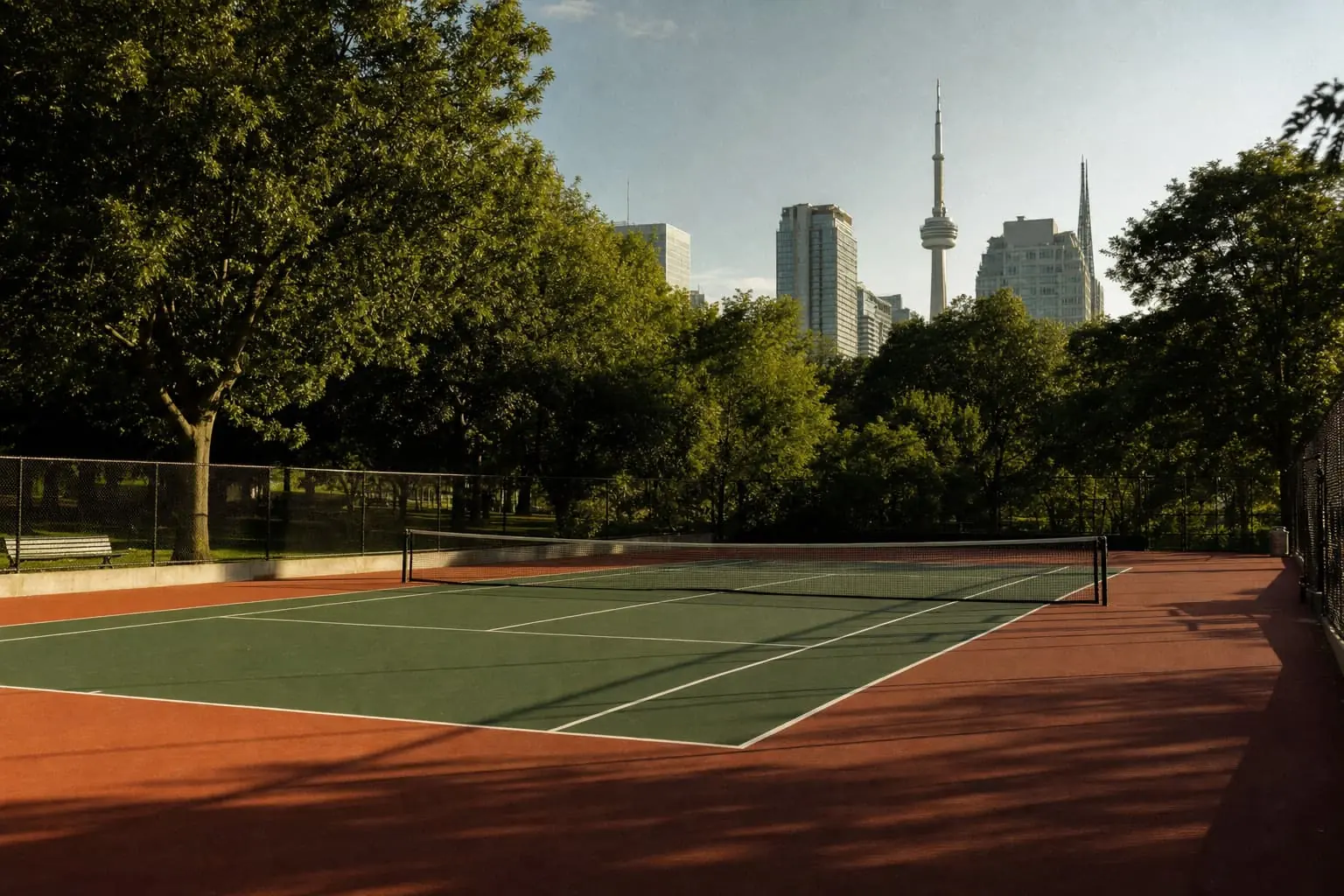
The Toronto singles ladder on Deuce is open, and it is free to join. Most public tennis here is played on City of Toronto park courts. The City lists 581 courts, and its public courts cost nothing: first come, first served, with a 30-minute sharing rule when others are waiting. Club-permitted courts generally keep six free prime-time public hours a week, excluding clay courts and L'Amoreaux Tennis Centre. The outdoor club season normally runs April to October, subject to conditions.
Toronto at a glance
| Ladders on Deuce | 1 |
| Active players (last 30 days) | 0 |
| Matches played (last 30 days) | 0 |
Ten players is enough to start a ladder. Below that we would rather tell you so than launch something that dies in three weeks.
Where you would play
Toronto has a large public court network that is free at the point of use and mostly outdoors.
The City's tennis court listing has 173 entries covering 581 courts. Public sites account for 310 of those courts across 106 entries, and 61 of the public entries have lights. Community clubs hold permits on another 269 courts across 66 entries.
Public park courts
Public courts are free and open at all times, and the City provides the nets. Play is first come, first served. When someone is waiting, the City asks you to share the court every 30 minutes, which matters for a ladder match: a best-of-three set match on a busy public court will not always get to finish uninterrupted.
A small number of courts can also be booked. The City's online booking system takes tennis court bookings from the same day up to seven days ahead, in one-hour minimum blocks, and online bookings are non-refundable. The City's 2026 fee schedule prices a tennis permit by the hour: CAD $11.50 for a not-for-profit adult booking, CAD $8.07 for children, youth and older adults.
Community clubs
Many Toronto park courts are run by volunteer community tennis clubs under a City permit. Those clubs must still give the public six free prime-time hours a week, posted on the City's listing (clay courts and L'Amoreaux Tennis Centre are excluded). Of the 55 clubs with a membership status on the City's list, 42 show membership as open and 13 show a waitlist. These clubs are the natural home for a ladder here.
Indoor courts and domes
From late fall the game moves indoors, into private indoor clubs and seasonal domes. The City's own fee schedule covers L'Amoreaux Tennis Centre in Scarborough, which sells winter court time: CAD $21.92 an hour off-peak for non-members and CAD $29.43 at prime time. Indoor time is the constraint that defines a Toronto ladder's calendar.
Toronto courts, from the City listing
| Site | Address | Type | Courts | Lights | Winter play flag | Booking |
|---|---|---|---|---|---|---|
| Eglinton Flats | 101 Emmett Ave | Public | 13 | Yes | Not listed | First come |
| Ramsden Park | 1020 Yonge St | Public | 12 | No | Yes | First come |
| Trinity Bellwoods Park | 790 Queen St W | Public | 8 | No | Yes | First come |
| High Park | 1873 Bloor St W | Public, plus 7 club courts (Howard Park Tennis Club) | 7 | Yes | Yes | First come |
| Riverdale Park East | 550 Broadview Ave | Public | 7 | No | Yes | First come |
| Norwood Park | 16 Norwood Rd | Public | 5 | No | Yes | First come |
| Cedarvale Park | 443 Arlington Ave | Public | 4 | Yes | Not listed | First come |
| Angela James Arena and Tennis Courts | 165 Grenoble Dr | Public | 4 | Yes | Not listed | First come |
| Fenside Park | 30 Slidell Cres | Public | 4 | Yes | Yes | Bookable online |
| Park Lawn Park | 330 Park Lawn Rd | Public | 4 | Yes | Not listed | Bookable online |
| Beaches Park | 2075 Queen St E | Club (Kew Gardens Tennis Club) | 10 | Yes | Not listed | Club, public hours posted |
| Rosedale Park | 20 Scholfield Ave | Club (The Rosedale Tennis Club) | 8 | No | Not listed | Club, public hours posted |
| Sir Winston Churchill Park | 301 St. Clair Ave W | Club (Sir Winston Churchill Tennis Club) | 7 | Yes | Not listed | Club, public hours posted |
| L'Amoreaux Tennis Centre | 300 Silver Springs Blvd | City tennis centre (Scarborough Winter Tennis Club) | 5 | Yes | Not listed | Bookable online |
When you can play
Toronto has the sharpest outdoor season boundary of any city in this set.
April to October
is the outdoor season. The City's policy for community tennis clubs says the club season normally runs April to October, depending on weather and court conditions. Summer is warm and humid, and the shoulder months are excellent.
November to March
is mostly indoor tennis. The City warns that courts may be closed in winter, though its listing flags 63 locations, with 200 courts between them, for winter play. Domes go up, indoor clubs fill, and court time becomes the most expensive on this list.
Recommended season length: ten to twelve weeks, starting in late May
Do not schedule an outdoor season that runs past mid-October. Standings should carry across the winter so the ladder does not cold-start every spring.
How a ladder works here
The shared mechanics are the same in every city. What changes here is the format, and it changes because of the court slot.
Outdoor public courts are unbooked, but the 30-minute sharing rule applies when others are waiting. Indoor courts are sold in fixed blocks and are expensive.
- Outdoors, quiet court. Best of three sets with a match tiebreak to ten in the third.
- Outdoors, people waiting, or indoors on one hour booked. An eight-game pro set, or short sets to four. It is the courteous default when someone else needs the court.
The mechanics
These are the defaults. An organizer can change most of them when the ladder is set up.
| Rule | Default |
|---|---|
| Challenge range | Five rungs up. Rung 6 may challenge rung 1 |
| Response window | 5 days |
| Play window | 30 days from acceptance |
| First challenge | One unrestricted challenge inside your own level band. Always on |
| Rematch cooldown | 14 days. Playing someone else does not shorten it |
| Absence | Up to 21 days. You keep your rung and cannot be challenged |
| Inactivity | Points decay every 30 days without a played match. Your rung is released at 180 days and you are withdrawn at 365 |
Standings carry across the off-season here, and it matters more than anywhere else on this list. A Toronto ladder that resets every May throws away five months of accumulated ranking every year. Keep the ladder's position history and restart the season, not the ladder.
Full ruleset at /rules. Scoring and verification at /scoring.
Levels and where you start
Tennis Canada uses WTN for Community Tennis Leagues as ratings become available. OTA adult tournament categories use NTRP self-rating. Deuce accepts both. Lower WTN numbers and higher NTRP numbers mean stronger players, so name the scale beside your number.
Deuce accepts whatever you have: NTRP, UTR, WTN, LTA rating, ITN, a national federation ranking, or a club level. All of them are optional. If you have none, describe your game and the system places you.
Two rules to know before you sign up:
- Low confidence places you high, not low. When we are unsure, you start at the top of the plausible range, never the middle and never the bottom. An underplaced player gets easy matches, which is the fastest way to ruin a ladder for everyone else.
- Your first challenge fixes it. One unrestricted challenge anywhere inside your band, played once, corrects a bad placement in a single match.
How the rating systems compare across countries is at the conversion table. What each NTRP level looks like in a match is on the NTRP rating chart.
How competitive tennis is organized in Toronto
For club introductions and a first casual hit, read finding a tennis partner in Toronto. It covers member access, local leagues, and agreeing on a court.
Toronto has a strong club culture and a competition layer that is mostly leagues.
Tennis Ontario
, the Ontario Tennis Association, is the provincial governing body for the sport, and its office is in Toronto.
Community tennis clubs
run much of the park court network, and many run internal leagues and ladders for members. These are the most likely home for a Deuce ladder in this city.
Interclub leagues
run through the InterCounty Tennis Association, founded in 1962. More than 100 member clubs, from downtown Toronto out to Barrie, field doubles teams in Mixed, Ladies, +55 and junior leagues, grouped into divisions of seven or eight teams.
Box leagues
run under Tennis Canada's Community Tennis Leagues program, which lists a Toronto league. You are placed in a group at your level and arrange your own matches over a four- to five-week session. Ontario singles entry is CAD $20 plus tax per session.
Club challenge ladders also exist
Moore Park describes a member social doubles ladder using challenges. Compare membership and format before choosing: a club doubles ladder, a self-arranged league group, and Deuce singles serve different needs.
Questions
Is there a tennis ladder in Toronto?
Yes. Deuce runs the Toronto singles ladder, which is open-ended and free to join. Many community tennis clubs also run internal ladders for their own members. The public alternatives are Tennis Canada's box leagues and interclub doubles, which assign your opponents rather than letting you choose.
Are public tennis courts free in Toronto?
Yes. City of Toronto public courts are free, open at all times, and played first come, first served, with nets provided. If someone is waiting, you share the court every 30 minutes. Courts run by community clubs are different: members pay a seasonal fee, and the public gets six free prime-time hours a week, excluding clay courts and L'Amoreaux Tennis Centre.
How do I book a tennis court in Toronto?
Most public courts cannot be booked: you turn up and play. A small set of City courts, plus L'Amoreaux Tennis Centre, can be booked online through the City's booking system, from the same day up to seven days ahead, in one-hour blocks. Online bookings are non-refundable and non-transferable.
What does a booked court cost in Toronto?
The City's 2026 fee schedule prices a tennis permit at CAD $11.50 an hour for a not-for-profit adult booking and CAD $8.07 for children, youth and older adults. At L'Amoreaux Tennis Centre, winter court time for non-members is CAD $21.92 an hour off-peak and CAD $29.43 at prime time.
When is the outdoor tennis season in Toronto?
The City's policy for community tennis clubs puts the normal season at April to October, depending on weather and court conditions. The City warns that courts may be closed in winter, although its listing flags 63 locations for winter play. For a ladder, plan outdoor rounds between late May and mid-October.
Where do I play in winter?
Indoors, mostly. Private clubs and seasonal domes take over from late fall, and indoor time is expensive and books up early. L'Amoreaux Tennis Centre in Scarborough sells winter court time at City rates, and the City's listing marks 63 outdoor locations for winter play when weather allows.
Do standings reset every year?
They should not. A ladder that resets each May throws away five months of ranking and forces everyone to re-sort from scratch. Deuce carries standings across the off-season, so a Toronto ladder restarts its outdoor season each spring without losing the order players earned the year before.
What rating does Canada use?
Tennis Canada Community Tennis Leagues use WTN as available, where lower is stronger. OTA adult tournaments use NTRP self-rated categories, where higher is stronger. Deuce accepts both, along with UTR and club levels, and your first unrestricted challenge corrects a placement that started in the wrong place.
What does it cost to join?
Nothing. Deuce Ladder is free for players right now. Outdoor public courts are free. Indoor court time is not.
How do I start one?
Below. You need ten players you can name.
Start a ladder in Toronto
For a club pro, a volunteer captain, a company team, or one person whose group chat has outgrown itself.
The application is ten questions and takes about five minutes. We review it and get in touch only if something needs clarifying. Once it is approved, the ladder is live and players can join and challenge straight away.
There is no self-serve wizard: every application is reviewed before the ladder opens.
You need ten players you can name. Twelve or more is where a ladder becomes self-sustaining, because that is the point at which the same two people stop playing each other every week. Under ten, apply anyway: we will tell you so rather than launch something thin.
If you already run a ladder in a spreadsheet, there is no import: invite your players once the ladder is approved, and the unrestricted first challenge sorts the order in a round.
Sources and last verified
- Tennis Court Listings, City of Toronto
- Online Booking Information and Conditions, City of Toronto
- 2026 User Fees, Appendix A, City of Toronto
- Policy for Outdoor Community Tennis Club Operations, City of Toronto
- Community Tennis Leagues, Tennis Canada
- About Us, InterCounty Tennis Association
- Ontario Tennis Association, Tennis Ontario
Last verified: September 2026.