
Cities
Tennis ladders in Shanghai
The Shanghai singles ladder on Deuce Ladder is open, free to join, and run in English. Shanghai had 1,958 tennis courts at the end of 2024, 392 of them indoor, according to the Shanghai Municipal Sports Bureau. You book public courts through the bureau's Lai Hu Dong (来沪动) mini-program or a venue's own channel. An indoor court at Xujiahui Sports Park was reported at 180 yuan an hour in late 2024.
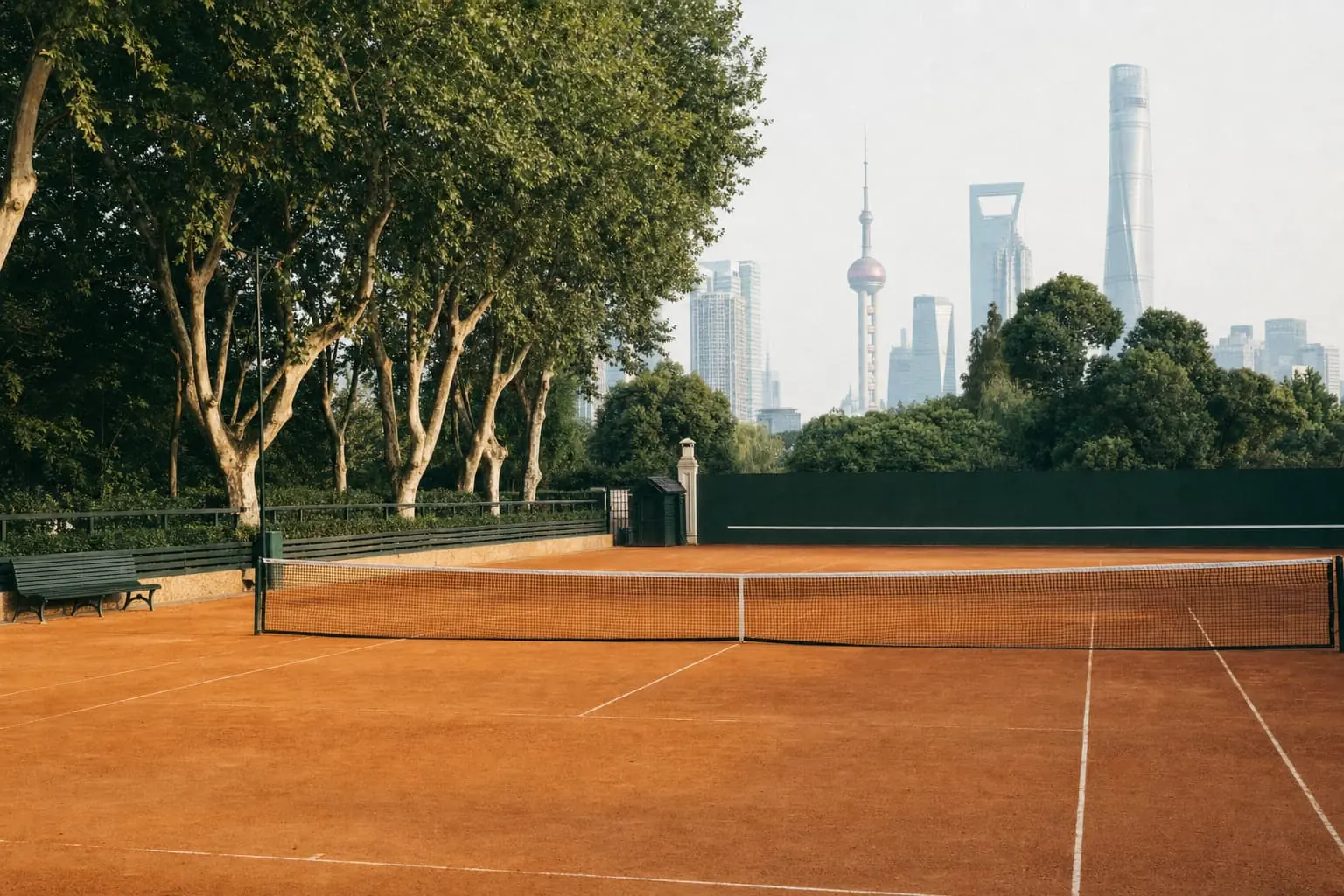
Shanghai at a glance
| Ladders on Deuce | 2 |
| Active players (last 30 days) | 0 |
| Matches played (last 30 days) | 0 |
Ten players is enough to start a ladder. Below that we would rather tell you so than launch something that dies in three weeks.
Where you would play
Shanghai has a large and improving court stock. The obstacle is not supply, it is access and language.
The Shanghai Municipal Sports Bureau's venue census counted 1,958 tennis courts at the end of 2024. Of those, 1,566 were outdoor courts and 392 sat inside 148 indoor tennis halls.
Public and commercial courts
Municipal sports centers, park courts and commercial tennis centers are spread across the city, with concentrations in Xuhui, Minhang, Pudong and Changning.
Booking. The closest thing to a city-wide platform is Lai Hu Dong (来沪动), the Shanghai Municipal Sports Bureau's booking mini-program. In December 2024 it listed 54 tennis venues with live availability. The other official channels are the Jiushi Sports (久事体育) app and each venue's WeChat official account. All of them are in Chinese.
Book on an official channel. In December 2024 a reporter from The Paper (澎湃新闻) bought resold slots through unofficial channels and paid 240 yuan for a court listed at 180.
Compound, club and school courts
For the international community this is usually the practical answer. Serviced compounds in Gubei, Jinqiao and Hongqiao have courts, several international schools rent theirs outside teaching hours, and the established clubs have good facilities for members.
Indoor courts
Shanghai winters are cold and damp and summers are punishing. The city's 392 indoor courts cost considerably more than outdoor courts, and they are what makes a twelve-month ladder possible.
Shanghai tennis venues
| Venue | District | Courts | Indoor | Listed rate | Note |
|---|---|---|---|---|---|
| Qizhong Forest Sports City Tennis Center (旗忠森林体育城网球中心) | Minhang | 16 outdoor, 6 indoor (April 2025, with a 17th outdoor court then being built) | Yes | Not confirmed | Home of the Shanghai Masters. Run by Jiushi Sports |
| Xianxia Tennis Center (仙霞网球中心) | Changning | 8 outdoor plus a center court | Not confirmed | 30 to 220 yuan an hour (reported in 2024) | |
| Xujiahui Sports Park (徐家汇体育公园) | Xuhui | 3 indoor, 4 outdoor | Yes | Indoor 180 yuan an hour (reported in 2024) | |
| Oriental Sports Center (东方体育中心) | Pudong | 3 outdoor | No | 80 yuan an hour (reported in 2024) | |
| Yuanshen Sports Center (源深体育中心) | Pudong | Halls A and B, count not confirmed | Yes | 170 yuan an hour (reported in 2024) |
When you can play
Shanghai has four distinct seasons and two comfortable windows.
April to May and September to October
are the best tennis months by a wide margin. October is also when the city's professional tournament runs, which helps a season launch.
Mid-June to mid-July
is the plum rain period (梅雨). On average it starts on June 19 and ends on July 10, according to figures published on the Shanghai government portal. Persistent, humid, wet.
July to August
is hot and humid, and midday play is not sensible.
December to February
is cold and damp. Outdoor play thins out and indoor courts become the product.
Recommended season length: eight weeks, starting in April or September
Do not run a season across the winter unless the ladder is built on indoor courts.
How a ladder works here
The shared mechanics are the same in every city. What changes here is the format, and it changes because of the court slot.
Courts are typically rented in one-hour or two-hour blocks.
- Two hours booked. Best of three sets with a match tiebreak to ten in the third.
- One hour booked. An eight-game pro set, or short sets to four.
In July and August, default to the one-hour format whatever the ladder is set to.
The mechanics
These are the defaults. An organizer can change most of them when the ladder is set up.
| Rule | Default |
|---|---|
| Challenge range | Five rungs up. Rung 6 may challenge rung 1 |
| Response window | 5 days |
| Play window | 30 days from acceptance |
| First challenge | One unrestricted challenge inside your own level band. Always on |
| Rematch cooldown | 14 days. Playing someone else does not shorten it |
| Absence | Up to 21 days. You keep your rung and cannot be challenged |
| Inactivity | Points decay every 30 days without a played match. Your rung is released at 180 days and you are withdrawn at 365 |
The thirty-day play window can come down in the good seasons. If a ladder runs through winter, keep it at thirty, because indoor courts are scarcer and booked further ahead.
Full ruleset at /rules. Scoring and verification at /scoring.
Levels and where you start
There is no amateur rating in common use among social players in Shanghai. UTR appears among competitive juniors. An English-language ladder here will be seeded almost entirely from self-description, which makes the unrestricted first challenge unusually important.
Deuce accepts whatever you have: NTRP, UTR, WTN, LTA rating, ITN, a national federation ranking, or a club level. All of them are optional. If you have none, describe your game and the system places you.
Two rules to know before you sign up:
- Low confidence places you high, not low. When we are unsure, you start at the top of the plausible range, never the middle and never the bottom. An underplaced player gets easy matches, which is the fastest way to ruin a ladder for everyone else.
- Your first challenge fixes it. One unrestricted challenge anywhere inside your band, played once, corrects a bad placement in a single match.
How the rating systems compare across countries is at the conversion table. What each NTRP level looks like in a match is on the NTRP rating chart.
How competitive tennis is organized in Shanghai
Shanghai has more organized tennis than most cities its size, and almost none of it is open to a newcomer who does not read Chinese.
The Shanghai Tennis Association (上海市网球协会)
sets the structure for amateur competition. In April 2024 it brought nearly 140 amateur competitions onto one platform, graded from S100 to S1000 by size and level. Players earn points that decide entry to higher-grade events, and one app handles registration and results. Nearly 10,000 people play these competitions each year.
Commercial academies and clubs
dominate the coaching layer and run internal social play.
Compound and school communities
are how most of the international population finds tennis: neighbors, colleagues, parents at the same school, coordinated on WeChat.
What is missing for an English-speaking player
is a standing ranking you can join without an introduction and without reading Chinese. The association's circuit is tournament-based and runs in Chinese. That is the specific gap this page addresses.
Questions
Is there a tennis ladder in Shanghai?
Shanghai's organized amateur tennis runs through the Shanghai Tennis Association's graded tournament circuit, in Chinese, plus informal groups inside compounds and schools. Deuce runs the Shanghai singles ladder. It is open-ended, free to join, run in English, and you choose whom you challenge.
How many tennis courts does Shanghai have?
The Shanghai Municipal Sports Bureau counted 1,958 tennis courts at the end of 2024. Of those, 1,566 were outdoor and 392 were inside 148 indoor tennis halls. Big public venues include Qizhong in Minhang, Xianxia in Changning and Xujiahui Sports Park in Xuhui.
How do I book a public tennis court in Shanghai?
Use Lai Hu Dong (来沪动), the Shanghai Municipal Sports Bureau's WeChat mini-program, which listed 54 tennis venues in December 2024. The Jiushi Sports app and venue WeChat accounts also take bookings. Everything is in Chinese. Avoid resellers, who charged a reporter 60 yuan above list.
What does a tennis court cost in Shanghai?
It depends on the venue and the hour. The latest published figures are from 2024 news reports: Xianxia Tennis Center ranged from 30 to 220 yuan an hour, the Oriental Sports Center had an outdoor court at 80 yuan, Yuanshen Sports Center a hall court at 170, and Xujiahui Sports Park an indoor court at 180. Check current rates on Lai Hu Dong or the Jiushi Sports app before you book.
When is the best time of year to play tennis in Shanghai?
April to May and September to October. The plum rain season averages June 19 to July 10, July and August are hot and humid, and December to February is cold and damp. An outdoor ladder should start in April or September and run about eight weeks.
Does this work if I do not speak Chinese?
The ladder does: Deuce runs in English. Booking a public court largely does not, because Lai Hu Dong, the Jiushi Sports app and venue accounts are in Chinese. That is why compound, school and club courts are the practical base for an English-language ladder here.
What does it cost to join?
Nothing. Deuce Ladder is free for players right now. Court fees are separate, and you pay them to the venue. Joining takes a few minutes: you declare a level, you are placed on a rung, and your first challenge can go to anyone inside your level band.
How do I start one?
Below. You need ten players you can name. Twelve or more is where a ladder sustains itself. The application is ten questions, Deuce reviews it, and the ladder goes live as soon as it is approved.
Start a ladder in Shanghai
For a club pro, a volunteer captain, a company team, or one person whose group chat has outgrown itself.
The application is ten questions and takes about five minutes. We review it and get in touch only if something needs clarifying. Once it is approved, the ladder is live and players can join and challenge straight away.
There is no self-serve wizard: every application is reviewed before the ladder opens.
You need ten players you can name. Twelve or more is where a ladder becomes self-sustaining, because that is the point at which the same two people stop playing each other every week. Under ten, apply anyway: we will tell you so rather than launch something thin.
If you already run a ladder in a spreadsheet, there is no import: invite your players once the ladder is approved, and the unrestricted first challenge sorts the order in a round.
Sources and last verified
- Shanghai Municipal Sports Bureau (上海市体育局): 2024 sports venue census, tennis court counts
- Chao News (潮新闻): Lai Hu Dong booking mini-program, December 2024
- The Paper (澎湃新闻): public court rates, booking channels and resale, December 2024
- Chinanews Economic (中新经纬), via The Paper: Xianxia Tennis Center courts and rates, August 2024
- Shanghai State-owned Assets Supervision and Administration Commission: Qizhong Tennis Center court counts
- Shanghai Municipal People's Government portal: average plum rain dates
- The Paper (澎湃新闻): Shanghai Tennis Association competition system, April 2024
Last verified: September 2026.