
Guides
Looking for a tennis partner in Melbourne?
In Melbourne, regular games grow out of clubs: team competitions on weeknights and weekends, run by district associations, and club social sessions. You get into a team through a club. For a game sooner, Royal Park, Carlton Gardens and Murrumbeena all run socials that non-members can join. To pick your own day and court instead, post a hit on Deuce Ladder’s Melbourne board.
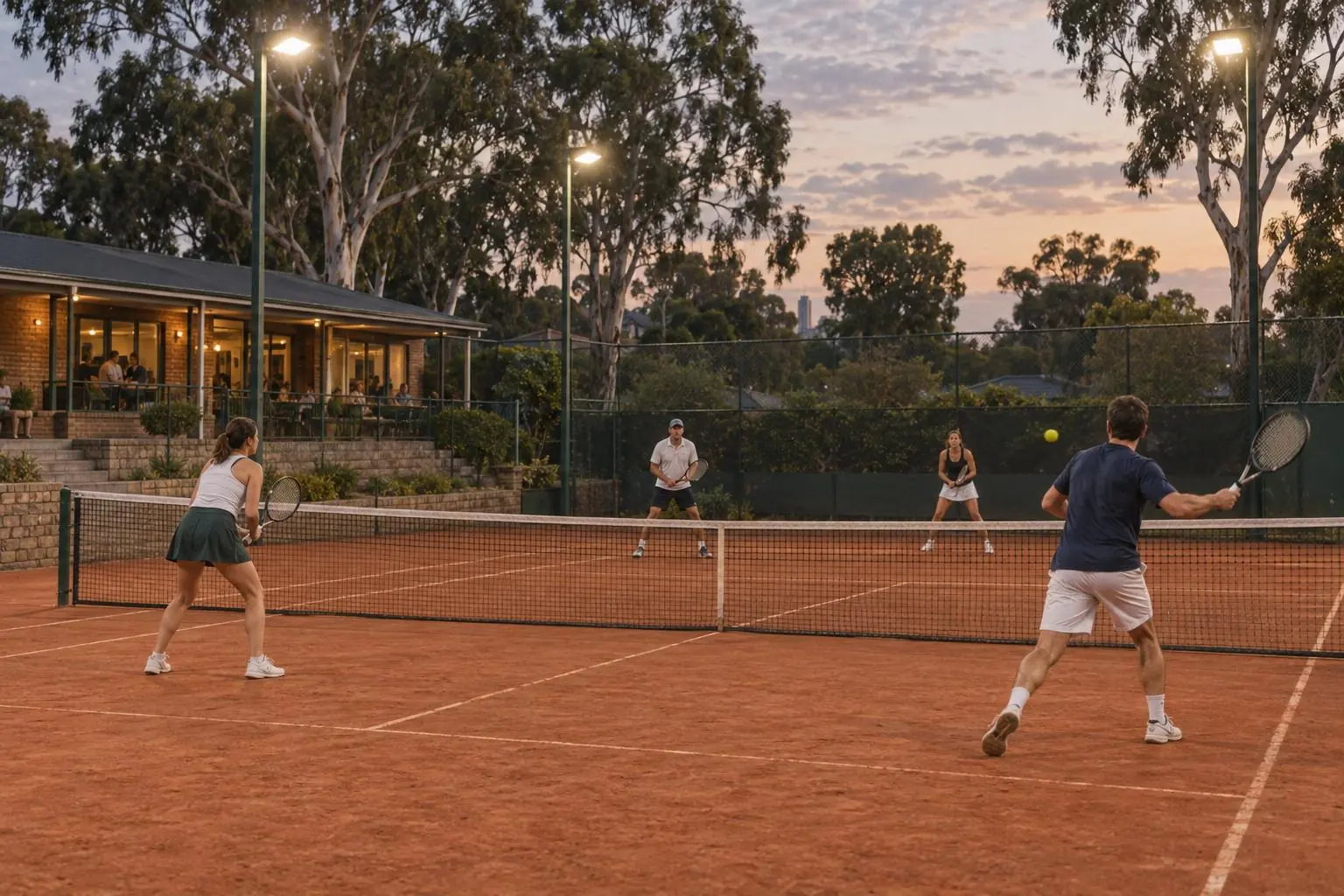
Where Melbourne players meet their partners
Clubs are the unit here, and the clubs play each other in district associations. Get onto a team and you meet teammates and a fresh set of opponents every week; by the end of a season you have numbers to call.
| Channel | How it works | Cost or entry | Level | Who runs it |
|---|---|---|---|---|
| Night competition | Club teams, weeknights under lights | Club membership plus A$8 to A$10 a player per night (BDNTA) | Sections and grades | Blackburn & District, North Suburban and other associations |
| Weekend competition | Club teams, Saturday and Sunday afternoons | Club membership; fees not on the association page | Sections and grades | Eastern Region Tennis and other associations |
| Tennis Victoria Pennant | Winter inter-club league, May to September | Club team; costs vary by club | Graded by Tennis Victoria | Tennis Victoria, through clubs |
| Club socials | Book or turn up, play whoever is rostered | Mostly A$10 to A$18 for non-members | Sessions labeled by level | Individual clubs |
| TennisCall listings | Search profiles, message a player | No price on the reviewed page | Self-described | TennisCall |
| Deuce board and ladder | Post an unscored hit, or join the ladder | Court costs separate | Board level labels; ladder level bands | Deuce |
You do not need all six. Pick one route for this week and one for the season.
District night competitions
In the east, the Blackburn & District Night Tennis Association plays four nights a week at suburban clubs. Its advice for joining has three steps: find an affiliated club near home, check the association’s published ladders (its tables by section) for a team at your level, then contact that club’s night convenor. Tuesday is the strongest night, Wednesday is more moderate, and Thursday has a singles and doubles section. Match fees are A$8 a player in the doubles sections and A$10 on Thursdays, paid to the host club on the night.
Watch the calendar. Team registration for the Autumn 2027 season opens on November 9 and closes on December 7, 2026. Popular clubs fill up: Box Hill Tennis Club says its night teams have a waitlist of about 12 months and asks players to register as fill-ins instead. That is a decent way in. When a team is a player short, the convenor may ring you.
In the north and west, the North Suburban Night Tennis Association runs the same kind of competition. Royal Park Tennis Club in Parkville plays in it and asks interested players to phone the club.
Weekend association tennis and Pennant
Eastern Region Tennis runs senior competition on Saturday and Sunday afternoons across nearly 80 affiliated clubs in the eastern suburbs. Its summer season started on October 10 and 11, 2026; winter starts in April.
Tennis Victoria Pennant is the governing body’s winter inter-club league, the biggest of its kind in the state by its own account. Most teams carry four to six players and rotate the line-up. Tennis Victoria is plain about entry: players do not enter as individuals; clubs enter teams. Ask a club’s competition coordinator or, with no club yet, send Tennis Victoria an Expression of Interest to be put in touch with clubs looking for players. Lower-grade entries closed on March 9 this year, so ask during the summer.
For Pennant and the other Tennis Victoria leagues, set up a Competitive Player Profile first. Expect to join the club: Murrumbeena Tennis Club, for one, requires its competition players to be members.
Club social sessions
Want a game this week? Try a club social. Prices below are as the clubs listed them in late October 2026.
Royal Park Tennis Club in Parkville runs socials for members and non-members from beginner to advanced, including a Sunday afternoon intermediate session at A$10 for non-members and a Friday evening advanced session at A$18. You book and pay on the club’s site. Its Meetup group says booking opens six days ahead at 9am and closes at 6pm the day before. The Friday group plays singles sets and rotates opponents.
Carlton Gardens Tennis Club runs volunteer-organized sessions through the week, from gentle mixed doubles to an upper-intermediate Fast4 night (short sets to four games). Non-members can join all except Sunday mornings, mostly for A$10; the Sunday beginners’ session costs A$30. Email the organizer and wait for a confirmation before you turn up. In the south east, Murrumbeena Tennis Club keeps it simplest: on Thursday nights from 7:30 to 9:30pm anyone can turn up for a hit, for A$10 if you are not a member.
Apps, listings and the Deuce board
TennisCall’s Melbourne search lists people looking for matches or score-free hits. A profile shows that someone signed up, not that they are free on Wednesday, so ask about a day and a suburb up front.
A Deuce board post takes a day, a start time, a length of 60, 90 or 120 minutes, the level you are after, and rallies or sets. Players ask to join and you accept or decline. Nothing is scored, and a hit never touches your rung. If the board is quiet, post your own time anyway and send it to someone you know. Posting does not guarantee an answer.
The board is for players 18 and over, and everyone ticks a box to say so. Answers go by email, so the other player sees your address once you reply or accept. If something goes wrong, the contact form has a Conduct reason for it.
Describing your level in Melbourne
On a club team, the opening question is your grade or section. “Tuesday night BDNTA” or “Pennant Grade 5 last winter” places you in a few words. Tennis Victoria grades Pennant teams on player standard, previous results, club nominations and competitive balance, so a grade describes a team more than a player. Say how often you played in it.
Behind the grades sits UTR. Tennis Australia calls the Universal Tennis Rating its official rating tool, a Competitive Player Profile links your Tennis ID to it, and BDNTA calculates its player ratings with UTR Sports. If you have a UTR, lead with it.
Visitors from the United States often bring an NTRP rating. Give the number and name the system; the NTRP rating chart shows each level in match terms, and the rating conversion table explains why systems do not map exactly. The ITF World Tennis Number matters here mainly for ITF-sanctioned events, where Tennis Australia requires it.
No rating? Describe a game. Do you hold serve? Have you played sets lately? Would you sign up for Royal Park’s beginners’ night or its Friday advanced group?
Getting the first game on court
With a social or a team fixture, the club has the court. A one-off hit needs one of you to book it. Tennis Australia’s court hire service books participating club courts online with no membership required. The Melbourne city page lists venues, rates and booking notice. Some venues take casual bookings only a day ahead, so agree the day, book as soon as the venue allows and settle who pays.
Agree a suburb, not “anywhere in Melbourne”: Box Hill is in the east, Sunshine in the west. Agree the surface too, because a court here might be hard, synthetic grass or clay. The city page covers the heat and the changeable weather; decide in advance who calls off a wet court and by when. Lights matter after work, and every court at Royal Park has them.
A first board note for Melbourne, with the date, time and duration in their own fields:
“New to Melbourne, played night comp doubles back home. Keen to rally, then play a set. Not booked yet: I can book near Carlton and we split the court. I’ll bring balls. If it rains or tops 35°C, we pick a new day.”
That is about 200 characters, inside the board’s 280-character limit. If plans change, say so before the other player leaves home. The guide to finding a partner who shows up covers the rest.
From one partner to a regular game
Here, a regular game usually comes attached to a fixture. A night team gives you the same evening every week for a season. Weekend teams play Saturday or Sunday afternoons. If your week is unpredictable, Tennis Australia points to social leagues, where club players opt in or out of each match.
The Melbourne ladder is the other route, for singles players who want results to count without a team or a fixed night. You challenge someone near your rung, agree a time and court, and both confirm the score; the response and play windows are on how Deuce works. The catch: it only works if other players accept challenges, and you still find the court. For the wider picture, see competitive tennis in Melbourne.
When Deuce is not the right fit
If you want team doubles on a fixed night with a club behind you, join a club and ask about a district competition or Pennant. If you want new faces every week and someone else organizing, a club social beats a board. For technique, book a coach. If your club already runs a ladder or competition you enjoy, stay with it.
Use Deuce when you can arrange your own court and want to post a specific time, or want singles results that move standings. It does not book courts or field teams, and a posted hit can go unanswered.
Sources and last verified
Last verified: October 30, 2026. Each source was checked during research and again after editing.
- Tennis Victoria: Pennant and playing in a league.
- Blackburn & District Night Tennis Association: home page and notices on TROLS.
- North Suburban Night Tennis Association: about.
- Eastern Region Tennis: home page.
- Box Hill Tennis Club: competition.
- Royal Park Tennis Club: home page, programs, night competition and its Meetup group.
- Carlton Gardens Tennis Club: social sessions.
- Murrumbeena Tennis Club: competition and social tennis.
- Tennis Australia: tennis ratings, Competitive Player Profile, playing in a league, court hire and Book a Court.
- TennisCall: Melbourne partner search.
- Deuce board and ladder behavior checked against the city registry, hit configuration and board messages on October 30, 2026.