
For organizers
Your students have lessons. They need matches.
You have adults who have taken lessons for six years and played fewer than ten competitive matches. They hit a clean forehand when you feed it and cannot construct a point once the score is being kept.
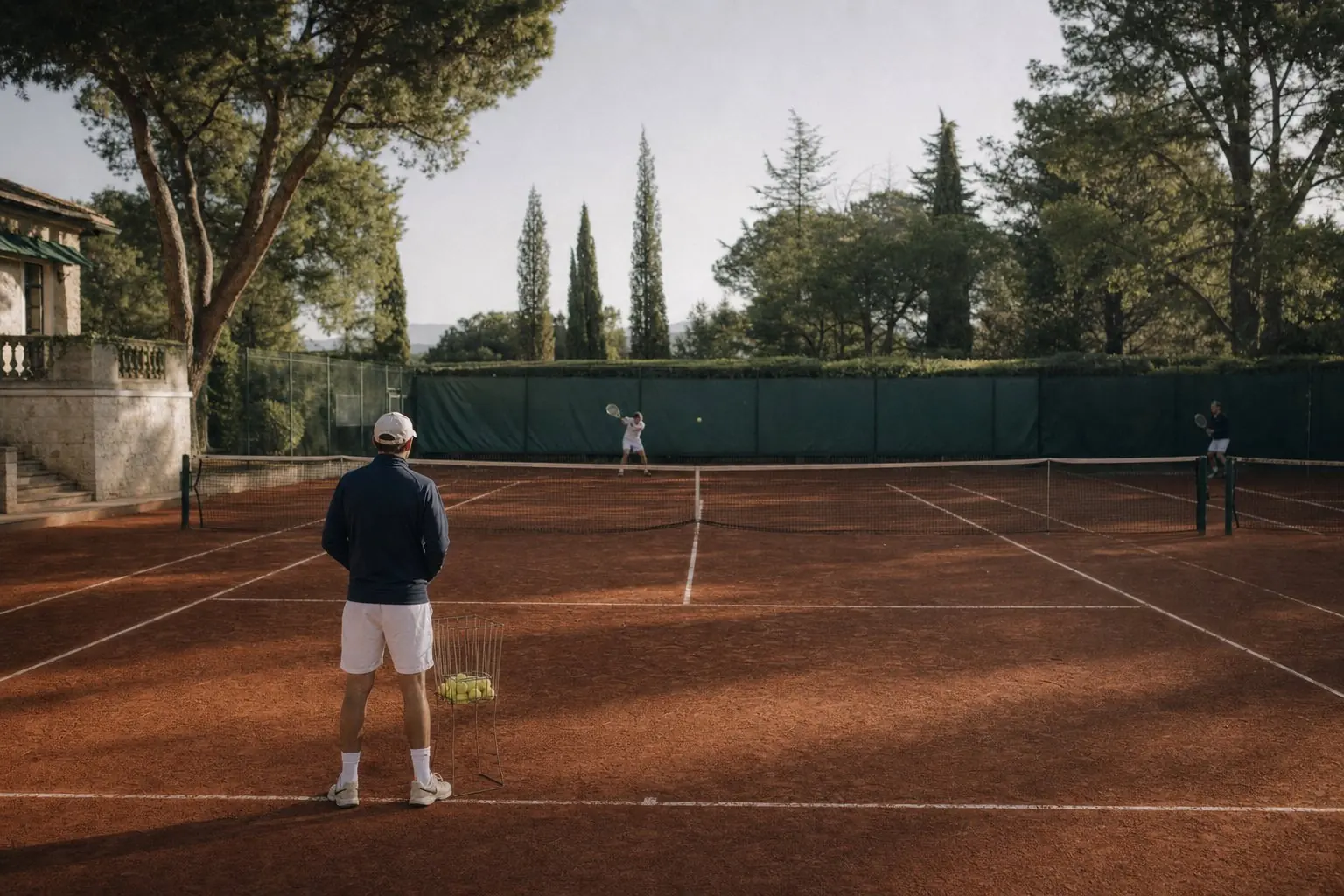
Three things that change in your week
The gap between the lesson and the match closes
A student on a ladder plays a competitive match most weeks against somebody near their standard, and turns up to the next lesson carrying a specific problem rather than a vague one: a slice backhand they could not read, every long rally lost, two double faults at 4-4. You cannot invent that in a drill.
Students get past the plateau
People quit when they can no longer see progress. A ladder puts it somewhere they can look at it: a rung they hold or do not, a win-loss record that moves, and a match history they can scroll on the drive home. A student climbing three rungs has a reason to book the next block, and so does the one who has now lost twice to the same opponent.
Something exists in front of people who have never met you
Every ladder has a public standings page with a permanent URL, indexed and readable without a login, and your students share it because their own name is on it. Be patient with that one: it works once there is a season of results on the page, not in week two. Put the link in your email signature and mention the ladder in the first lesson of a block rather than the last.
If you have tried matchplay before, you have probably tried it inside something not built for it. UTR runs flex play with no ladder, and its challenge matches must be emailed to an administrator. USTA Flex takes the choice away from the player entirely:
At the start of each 2 week round, players are automatically assigned to 0, 1, or 2 opponents based on their availability.
USTA Flex league rules, as published
For a coach that assignment is the problem, not the feature. You want your 3.5 playing the other 3.5s you teach, in an order that reflects how they are actually hitting.
Setting one up for the people you already teach
Make it closed
Set the ladder to invite only and it holds exactly the people you teach.
Level bands keep the matches worth playing
Split by standard, not by which class they attend. Two bands of twelve produce far more played matches than one ladder of twenty-four, for the obvious reason: a 3.0 who draws a 4.5 loses 6-0 and never enters again. Seed the order yourself, since you know your students better than any rating does, and every player's unrestricted first challenge will correct you inside two weeks wherever you got someone wrong.
Take your court reality seriously on format
Six formats can be recorded, from best of three down to FAST4. Pick the one that fits the slot your students can book, because a format that does not fit leaves matches unfinished, and unfinished matches are where disputes come from. Ninety-minute bookings? One set with a tiebreak.
Deadlines do the chasing
A challenge has 120 hours to be answered and thirty days to be played, both enforced by the software. Coaches underrate this until they have run matchplay once: the format is easy, and the chasing is what kills it. A student who lets the response deadline pass concedes a walkover automatically, and it was published before a single student joined, so when a parent asks why their child dropped a place, you send them the rule.
Juniors work, with two cautions
Juniors and their parents make a ladder busy fast, so keep the bands tight and the format short, and make sure parents can read the rules. Worth knowing before a parent asks: a walkover is conceded by never answering a challenge, and a forfeit is accepting and then giving up. The second caution is safeguarding. If your ladder involves under-18s, read the consent and contact-visibility rules with whoever holds that responsibility at your club, and ask us anything they cannot find before you launch.
Absence keeps students you would otherwise lose
Exams, a shoulder, three weeks of work travel. A student can declare up to 21 days, holding their rung and staying out of challenge range. Without that valve people quit instead of pausing.
If your student base is small or lumpy (most independent coaches' are), run one wide band rather than two thin ones and shorten the season. Six weeks with twelve players beats twelve weeks with seven, because the second runs out of fixtures in week three.
What a student does when nobody is feeding them balls
You already assess your students every lesson, whether you write it down or not. What you have never had is a record of what they do when nobody is feeding them balls.
Every played match is confirmed by both players and kept. The coach view shows, per student, matches played, opponents faced, results split above and below their own rung, and rungs climbed across the season. It is a match record, not a survey. That view is part of what we are building for launch, and if it is not ready you will find out from us rather than from a screenshot that does not match the product.
Coaching
You see the pattern the student cannot describe about themselves: they beat every pusher in the band and lose to anybody with a serve, or they keep taking first sets and losing tiebreaks. Read four of those records in a row and you have most of next term's lesson plan.
Renewal conversations
At the end of a term you are not asking a student to take your word that they improved. Whether that helps you renew them is your judgment, not a claim we can evidence. We have no retention data because we have no customers. What we can say is that the record exists and it is theirs as well as yours.
The windows, formats and thresholds quoted here were last checked in September 2026 against the published ruleset. They are set per ladder, and where a number here differs from the ruleset, the ruleset wins.
What it costs
Pricing is not published yet. It goes on the pricing page the day it is real, in public, with no call required to see it, and it will say which side the bill lands on, whether the unit is the ladder or the student, and what happens if your term ends early.
Meanwhile the useful thing costs nothing: count the students you could name for a ladder today, and decide which court slot you would give it. Those are what the application asks about anyway.
What belongs here: one named coach or academy, city, and the size of the student base, with numbers that speak to a coach's actual economics: - Students enrolled in the ladder, and how many played a match in the last 30 days - Matches played per student per month - Lesson retention or re-booking rate among ladder students versus non-ladder students. This is the headline figure for this audience. A coach buys students who keep booking. - New students who arrived via the public standings page Plus a link to the ladder's public standings page.
What would make it credible: 1. A named coach with their qualification and their club or academy. Coaches buy on peer reference more than on features, so an anonymous case study is worth nothing here. 2. A single student's arc told concretely: their level when they joined, matches played, where they finished. One specific student beats an aggregate. 3. What the coach still does manually. A coach who has been sold a platform before will look for the omission.
Recruit from the first coach-run ladder that reaches a full term. Until then, render nothing at all. -->
If you wear more than one hat
Running a ladder for a park group or community club,
not just the people you teach. The organizer page covers the same mechanics from the running-it side.
The club is buying, not you
Retention, court utilization and data ownership are what your committee will ask about.
Start with one band
One ladder, twelve students, one term. Enough to find out whether your students take to it, small enough that it does not matter much if they do not. The application is 10 questions and takes about five minutes, and the ladder opens for players once we approve it.
You name the students and the band, we approve it, and you send one email. Week one, the first challenge goes out. By week three you are hearing about matches in lessons instead of asking about them. Around week five a student who has not played gets quietly overtaken by the ladder itself, and you have not had to mention it to anybody.